
Going Small with a GWR Branchline 1890-1920
Posted
#246577
(In Topic #13614)
Full Member
GWR Branchline in EM Gauge 4mm Scale
Hi AllAfter an enforced break from modeling for the past few months (which gave me lots of time for research, pondering, planning and scheming) it's back to the grindstone. And another series of challenges. First the easy bit - it's the GWR. :doublethumb. I keep hearing stories about other companies in far flung corners of the isles. Just gossip I understand. Now for the challenges:
Track. EM gauge so any available RTR locomotives, coaches and wagons need modifying. For RTR locomotives I like Ultrascale wheel sets, which can mean a long delay (5 months minimum from past experience) and custom ones will be even more expensive and even longer. I also like Markits wheels. Which currently are like hen's teeth. The track is not an issue. I have a large quantity of RTR EM gauge track available, plus a load of stuff from C+L to make track, and I need to make 7 points.
Locomotives. Branchlines mean small tank locomotives. Not that much choice in RTR for this period. The 0-6-0 Class 2721 of 1897? Hmm. I had one of those some time ago. Out of scale and a PITA to do put in DCC sound. Class 1361 0-6-0? No, only 10 built in 1910 and with outside pistons (and I believe one manufacturer went bankrupt earlier this year). And it's not looking so good in kits either. No longer available for nearly all of them. However, the Class 2021 saddle tank kit is a good candidate and is available. Which is good, because this was the major locomotive on the line until the 57XX and 14xx classes came along in the late 1929-1930's. Lots of autocoach workings, so a Class 517 or a Metro tank is also on the list. Which is unfortunate because most kits are currently no longer available. However I have a cunning plan for an old K's 14xx body and chassis stored in the spares box, and they just happens to be the exact dimensions as a Class 517. Interesting that. :hmm The usual butchery and hackery will be necessary. Needs a Dean chimney and a 517 dome, both are available. If that doesn't work then a 517 or Metro tank kit it will be. Which then gets me to the third locomotive required, the GWR steam railmotor. This is on a "forthcoming" list from one supplier. Good so far. So, I inquired as to whether any consideration had been given to making sure the driving and trailing bogies could be modified to EM (or P4). Short answer "No, and it was now in the hands of the Chinese CAD people". I have ran into issues before where the body is scaled to 4mm, but the chassis and especially the pistons//valve motion are scaled to 3.5mm with outside cylinder models. Now brass body etches of exactly the same prototype are available although it's the Diagram R and is a bit long at a scale 70 feet. One of the earlier diagrams with a length of around 60 feet would be better. Still researching this one. I did note that the P4 Society is (was?) developing a driving steam bogie. The probable alternative is some frames along with a scratch built Walschaerts valve gear setup. Oh joy!
Passenger coaches. Usually 4 and 6 wheelers were the norm, so plastic kit 4-wheelers for the moment with brass etch sides, and some of those Genesis Project generic ones coming in 2021 look good even although they matcth no prototype (already got an order in for some). Plus an autotrailer/coach. RTR models are Collett or Hawsworth models, I need one that looks like it was used in 1910, not 1950! Brass etch body kit again, or possibly a bash of an old RTR model. I like the idea of matchstick sides.
Siphons. The only RTR models are G or H bogie affairs. What is required are some 4 and 6 wheels designs. Etches for the body of the Siphon C are available, just needs a chassis.The 6-wheeler is still under investigation.
The GWR ran Toad brake vans considerably smaller than the ubiquitous 20 ton one done by the RTR folks. 10-16 tons. Some license may be required here, but it won't be the 20 ton version.
Wagons will be 3-link, preferably pre-RCH designs. Kits will probably be predominant here.
Those are all minor issues. The major one is space. My modeling space is basically 4.5 x 5 feet, so it takes a bit of ingenuity to get an 11 foot long 15" wide layout plus 3-foot fiddle yard in there. The balcony (all 36 feet x 6 feet of it) is out, so it will be modular and portable. I'm using Baltic birch ply and Radiata pine for the construction, which is almost complete. As usual DCC sound operation.
With only 3 locomotives it's not a heavy burden on the wallet, and the amount of stock required is minimal (3-4 coaches, 2 Siphons, a couple of cattle wagons, and coal and freight wagons). Strict discipline here, no impulse buys or stretching the period modeled to include other locomotive models or coaches that look tempting and shiny.
The branchline I am modeling just about fits into an 11 foot length with minimal compression. so that's another bonus. The station, goods shed and signal frame cabin are all available in card kits (although that took a bit of searching), that should keep the weight down.
More shortly.
Nigel
©Nigel C. Phillips


Posted
Full Member
Your research looks to be spot on and I hope the requisite kits fall within your grasp before too long. After looking for some months, I finally found a Metro and 517 on ebay, although someone has already bodged the 517 chassis, but no big deal. The Airfix / Hornby 14xx however is a natural candidate for 517 bashing and will be a most worthwhile project.
Very best of luck and I am very much looking forward to your build, almost as much as yourself.
Best,
Bill
 Last edit: by Longchap
At 6'4'', Bill is a tall chap, then again, when horizontal he is rather long and people often used to trip over him! . . . and so a nickname was born :)
Posted
Full Member
There is a fair choice of RTR tender locomotives for this time frame, but not small tankers. Metro tank engines. There is a kit available, along with one for the 517. Plus the frames are commercially available, as are horn blocks. I have given up on eBay, it will up the price with their standard shipping/customs pricing by about £20 or more.
I had thought about converting the Hornby 14xx as I still have the EM wheelset, but the conversion is not amenable to an open cab as the motor sits right in the middle. I have that old K's 14xx body shell and chassis, which was already EM converted, and which runs sweetly when it has wheels on. The body shell dimensionally is spot on for a 517 with closed cab, tank and cab excepted, so the plan is an open cab, modified bunker, new narrower front sheet with spectacles, modified side sheets and wider tanks. Dean chimney and dome as they are quite different to the 14xx.
Should be fun, although that Walschaert's valve gear on the steam rail car could be…interesting. Luckily frames are available for the chassis, which takes a lot of worry away. I'm hoping not to have to do a custom etch for the valve gear.
I have a couple of other locomotives from the same time period in the build stage - that outside frame tender 0-6-0, and a Taff Vale 0-6-2 side tank (precursor to the 56xx).
It was nice having some time to get this one planned out. Not for everybody's taste, but basing the stock on the prototype operations and the vehicles used keeps it on track. And yes, there will be some horse power to the nearby town.
Nigel
©Nigel C. Phillips
Posted
Full Member
Connor
CC Weathering Services: https://ccgwr1.wixsite.com/ccweatheringservices/
CC Weathering Services Facebook Page: https://www.facebook.com/ccweatheringservices/
CC Weathering Services Facebook Page: https://www.facebook.com/ccweatheringservices/
Posted
Full Member
3D prints, especially in white, natural, and me do not get along. Because of the nature of the plastic polymer used (nylon in natural white) they do not readily glue together. Even with plastic-specific superglue. That and the amount of work to get a smooth finish (which even then shows the layers, the smooth polished white versions still need work), which also messes up finer details.The pricing is another issue, the Shapeways one requires 3 parts, chassis, body, and roof. Pricing is based on volume, anything box-like is expensive. Add in the detailing and it gets really expensive.
Still researching the 6-wheeler. And of course they need Mansell wheels.
Nigel
©Nigel C. Phillips
Posted
Full Member
Bill
Last edit: by Longchap
At 6'4'', Bill is a tall chap, then again, when horizontal he is rather long and people often used to trip over him! . . . and so a nickname was born :)
Posted

Full Member
When I were a nipper and made stuff (and Noah was a boy) I used Coopercraft kits of GWR wagons on my 1920's layout as they were of the right "age". Not sure of they will take EM gauge axles but they are still in production and in fact have just restarted distribution having acquired a new pastic moulding machine.
I only know this because they own the LNER Kirk coach kit moulds and I have been waiting for the artic sets to come back to the market.
If this is all old news, I apologise and will go back to my packing………. :pedal
Barry
Shed dweller, Softie Southerner and Meglomaniac
Posted
Full Member
Good point. I have my eyes on several of their wagon kits, specifically because they model (or are capable of being modified) pre-1920 stock. Also Cambrian Model Rail. Unlike the RTR manufacturers, they do indicate the Diagram code/number, which means any post 1920 models can be eliminated.
Moving out any kit or RTR wagon to EM gauge is usually OK, some kits even have 2 positions for the frames - OO and EM/P4. From memory I think Coopercraft do this. The brake shoes often need repositioning or thinning down unless fine-scale wheels are used. I'm not planning on going fine-scale, although with some of the brass etch kits they are already there. Decent wheels (not so I need to spend too much time on points and frogs), 3-link coupling and sprung buffers, plus some under-frame detailing. Odd rivet out? - Not a great concern.
Nigel
©Nigel C. Phillips
Posted
Full Member
Bearing in mind the extensive research you will have completed, you surely would have seen the Swansea Railway Modellers website and here's a refresher if you want to catch up on their projects:
https://srmg.org.uk/one-for-the-milk-train
I too have been searching for redundant kits for smaller brake vans, so good luck there, as the few I've seen on ebay go for silly money. I think there's a current kit for an ex-Taff Vale road van. I'll let you know more if I find anything useful.
EDIT: Have tou seen Diagram 3D kits? They do GWR 4 and 6 wheel Siphons and coach wheel sets with Mansell inserts. I like the look and construction of their kits after watching the build video and extra detail is easilly added. You can also download all the kit instructions from their site and I think I'll order a sample kit to see how it goes.
https://www.diagram3d.com/index.php?route=common/home
Bill
Last edit: by Longchap
At 6'4'', Bill is a tall chap, then again, when horizontal he is rather long and people often used to trip over him! . . . and so a nickname was born :)
Posted
Full Member
Yes to both. The D3D looks interesting, but no chassis. A 6-wheeler is on the nice to have list. Two 4-wheelers or a stretched 4- to 6-wheeler is a possibility.
Same here with a small Toad. Taff Vale have an interesting range in 4mm, which of course ended up with the GWR post grouping. Which is 2 years on from my upper modeling date.
DIY looks more likely. As does custom.
Nigel
©Nigel C. Phillips
Posted
Full Member
This sounds like a brilliant project, have you got a track plan or ideas you're able to share?
Colin
Posted
Full Member
The track plan is going to be as found in one of my favorite GWR branch lines, more on that later. If the GWR got it to work, why change it. The terminus just fits with a bit of compression at the ends into the space I have available.I will be taking perhaps one liberty with history.
The list is:
EM gauge track and points, code 75. Hand built points.
Small fiddle/sector plate (3 tracks).
Prototype timetable.
Wire in tube point operation using components from Fast Tracks (the 'Sidewinder"). Based up in Canada, at least I can avoid the shipping from the UK.
3 small steam locomotives (2021 Saddle, 517 side tank, steam railmotor, looks like all will be kit or bashed).
Four- and 6-wheel coaching stock, plus a bogie trailer. Kit for the trailer. I might even do a private saloon for one of the local estates.
Couple of 4 and/or 6 wheel Siphons for the milk trade.
Cattle wagon.
Horse box.or 2 (for the local hunt).
Carriage wagon (as intended when built, for a horse drawn carriage).
Coal wagons - domestic and cannel coal (for the local gasworks). Suppliers as shown in the records. I will need appropriate transfers.
Rectangular tar wagon (from the local tar distiller, side product of the gas works). No coke out, gas works coke was cunsumed locally.
A few assorted vans (Minks for example).
Early Brake van. Not the 20 tonner!
3 link coupling with full size shunter's pole from the sky. No RTR couplers and definitely no magnets.
DCC sound operation.
The aim is as much hands-on construction as possible, along with hands-on operation, points physically thrown, wagons and coaches uncoupled and coupled manually. I enjoy building, bashing, modifying and bodging as much as operations, so this fits the bill. Hand from the sky is normal over here. I've been researching and planning this pretty much since January, when life got in the way of modeling for quite a few months. The aim is simple, a layout based on prototype operations on a small branchline with the corresponding requirements for stock. No shiny and no going outside of the time frame. That is deliberate, as the GWR went from brown and white through brown to crimson lake (with a bit of khaki in WW1), and then back to brown and white in 1922. One engine in steam, one replacement for when the boiler on one gets washed out or a minor service is required, steam railcar on trial, short trains, passenger and goods, often mixed. Like many GWR branchlines, it was not built by the GWR, so something different to GWR designs with respect to the buildings. And of course getting all of this to fit in my limited space. Modular design and easily stored and transported.
The baseboards are almost completed (Baltic Birch/Radiata pine), I have one more to do, and will then show some photos of the system I came up with.
Nigel
©Nigel C. Phillips
Posted
Full Member
Hi Nigel
When I were a nipper and made stuff (and Noah was a boy) I used Coopercraft kits of GWR wagons on my 1920's layout as they were of the right "age". Not sure of they will take EM gauge axles but they are still in production and in fact have just restarted distribution having acquired a new pastic moulding machine.
If this is all old news, I apologise and will go back to my packing………. :pedal
Barry
Hi Barry,
On reading the above I thought I'd check for the latest info, viz.
Cooper Craft remain dysfunctional according to latest I've read elsewhere. The "new Machine" is indeed old news, has not / cannot be operated and according to reports, recently when the owner turned up at a show he had just a few old kits of his own he was trying to "flog off". Don't hold your breath!
Last edit: by Colin W
Posted
Full Member
When a manufacturer announces a hiatus, and then nothing happens, you know there is trouble at t'mill. I am aware of the RM thread. The complainers seem to be as naive as the vendor. Not the only source of stock for this period, and as my needs are few and simple not a layout stopper. Most post grouping kits or rtr stock can usually be backdated with little effort. If necessary an appropriate wagon chassis can be used.
The hobby has an unfortunate history of small suppliers going out of business and the tooling disappearing forever. Or being bought and never continued. Nothing new here.
NIgel
©Nigel C. Phillips
Posted
Full Member
Yes I indeed appear to have got all excited about old news - the "Exhibition diary" features plans for 2014!!!
Barry
Shed dweller, Softie Southerner and Meglomaniac
Posted

Full Member
Life has got in the way of modelling for me too for the past few months - I'm glad that you are able to get back to it now!
Regards
Michael
Posted
Full Member
More like run for the hills! Nothing ambitious, except to try not to have too much rtr stock. I found a source for 1900's wagon frames, so it's either rtr bodies or scratch.
Nigel
©Nigel C. Phillips
Posted
Full Member
I have finally found some time to make a start on the baseboards. Nothing complicated, frames of 2 x 1" nominal Radiata pine (1.75" x 0.75" actual), tops of 9mm Baltic birch ply. The frames are a new dimension for me, I am not planning on a lot of electrical/electronic hardware underneath, just the wiring and power sector/short circuit protection, so a lot of height is not a requirement (no motors planned at the moment). It also helps with storage. The module frame height is fine for the manual WIT point/frog switches I am planning on using. Not that a frog polarity switch is essential for hand-built turnouts, but I will be using small 0-6-0 and 0-4-2 tank locomotives..
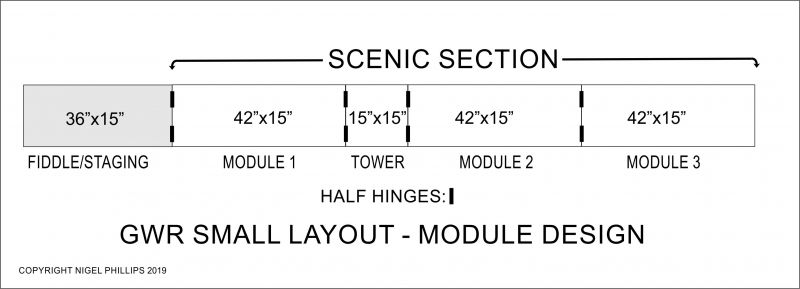
The module plan call for a 15" x 15" w/d central tower (with 2 storage shelves) on wheels, to which modular sections (3 modules each 42" x 15") will be joined using half hinges.That gives me a 12 foot-long layout plus a fiddleyard/sector plate, so 15 feet in total. The layout will store in a 3' x 2' x 4' space (w/d/h), and will also lay in the back of the car. Two of the modules will simply hang from the central tower for storage. The third module will hang from the back, the fiddle yard/sector plate from the front. More on that later. First module on the getaroundtoit list is the fiddle yard /sector plate. Three and a half hours last night at the woodworking shop produced the following:
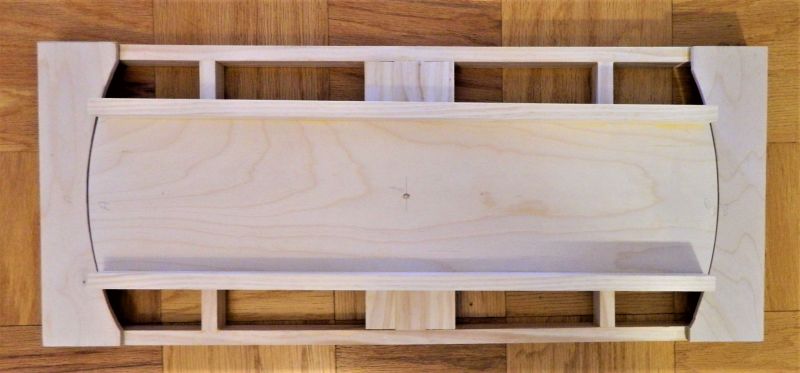

Length 36", width 15", with a 30" rotating sector plate that will hold 3 tracks. The pivot is currently a 1/4 dowel, that will be replaced with a 1/4" bolt. I have some HMW poly sheet on order, a few coats of rattle can urethane spray on the bottom of the plate and the HMW poly on the frame will give an almost friction-less movement. One finger-power in fact. A 30" track length on the plate is fine for the short trains I will be running. Running the track to the end of the board will allow a folding cassette board to be used if required, although I may just use one of the side tracks on the plate for that. Trying to keep away from the "Topsy" syndrome. Still thinking about that one. Open frame construction (weight and the cost of Baltic birch ply, ouch!). The curves were measured using a "nail and pencil and wood" protractor and cut using the band saw. Too big for a jig as the shop was crowded last night, so slow and easy by hand, followed by a touch-up on the spindle sander. Glue and dowel construction for the frames. The plate has 1.75" high sides, so that should stop things from falling off.
Some more 9mm Baltic birch is supposed to be arriving at the local wood store this afternoon, so I can then complete the other 2 modules (I did the frames last night after I set up the frame for the fiddle yard/sector plate, waiting around for glue to do its thing is not productive, and cutting the plate/ends only took 5 minutes).
Module diagram coming up to give an idea of what I am doing.
Nigel
©Nigel C. Phillips
Posted
Full Member
Module diagram. The tower unit stands 43" high. Correction to the overall length, (3 x 3.5') + 1.25' is 11.75' :oops: Still plenty of room for an almost 1:76 model. There is a small compromise on the width, but apart from that the track plan is pretty much as the prototype. I'll show how the half hinges work when I have some tops on the frames. Modules 1 and 2 fold flat against the tower, module 3 to the back for storage, fiddle/staging to the front. Which means it can be wheeled to the car, not carried. The top of the tower is actually a small module that is bolted to the tower for home use, so it and the other modules are also designed to sit on a couple of trestle tables. Important for shows, with small un's and those in wheelchairs/electric chairs.
The terminus end will be on module 3, so I recon this will work best with 2 operators - DCC control is in the tower in the middle, most of the WIT will be on modules 2 and 3. The fiddle/staging module is not designed to be hidden or enclosed. Scenic break between Module 1 and the fiddle/staging yard. No bridges for a few miles on the real thing, so maybe a bit of Rule 1 will be applied here. Maybe a small cutting rather than the ubiquitous tunnel or bridge. Following the examples from members of this club I will probably scenic the first few inches of the fiddle/staging module.
One of my railroad buddies here is all for small layouts, so perhaps he can give a hand at shows and the scheduled open house next year.
Nigel
©Nigel C. Phillips
Posted
Full Member
More carpentry.
Central tower with modules 1 and 2.

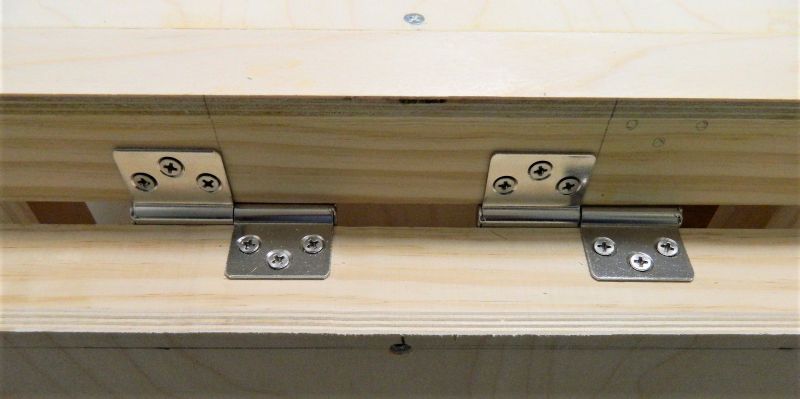
"The things wot 'old the candles". Rather, the half/sliding hinges (also known as "lift off" hinges). Module 1 attached. I used 2" x 2" nominal Radiata pine at the edges of the central tower top to give a decent anchor for the screws.
Model 1 detached.

Module 1 extended on temporary leg.

The hinges (closed)

The hinges (open).

Module 3 frame.
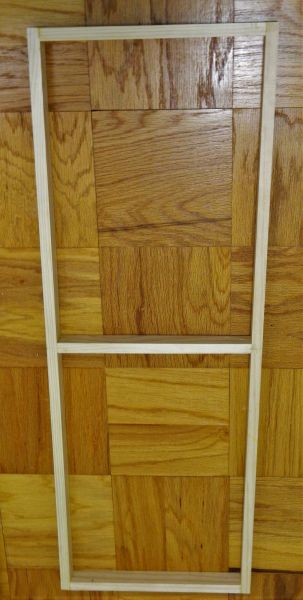
Remaining jobs: Top on the module 4 frame (the 9mm Baltic Birch ply arrived yesterday, needs cutting to size); legs for the modules (2" x 1" Radiata pine with Baltic Birch bracing, adjustable supports at the bottom); wood filler and sand where necessary; paint.
The ultra-high molecular weight polyethylene (UHMW PE) arrived yesterday, so the fiddle yard/sector module can be completed.
Next up will be the track.
Nigel
©Nigel C. Phillips
1 guest and 0 members have just viewed this.