
How I make wire frame trees
Posted
#1736
(In Topic #357)
Guest user
coconut fibre from hanging basket liner
DAS clay
Heki foliage mat
PVA glue
acrylic paint [cheap :D ]
I grab about 8 strands of fairly fine copper wire and twist them into a 'cable'. Working upwards from the base I separate 2 or 3 strands and twist them into branches, trying to keep lowest branches thickest.
I find it works well to add in single strands wherever more branching is needed. If I secure either end of added wires, then cut through the resulting loop, I get 2 more branches. To get age into your tree, avoid low branches that grow upwards. Low branches are the oldest, so will usually be roughly parallel to the ground, or even angled down towards it. This is something of a generalisation, of course, but it's a tactic that Bonsai growers use. My apologies if this is obvious - i'm just trying to cover all I can think of.

The tree I'm making will have a heavy base and twin trunks, so I'll make two of these.
The two frameworks are joined together with PVA glue and are encased in DAS clay. Clay is moulded over heavy branches to disguise the spiral effect of twisted wire, then it's coated with more PVA glue to prevent crumbling.
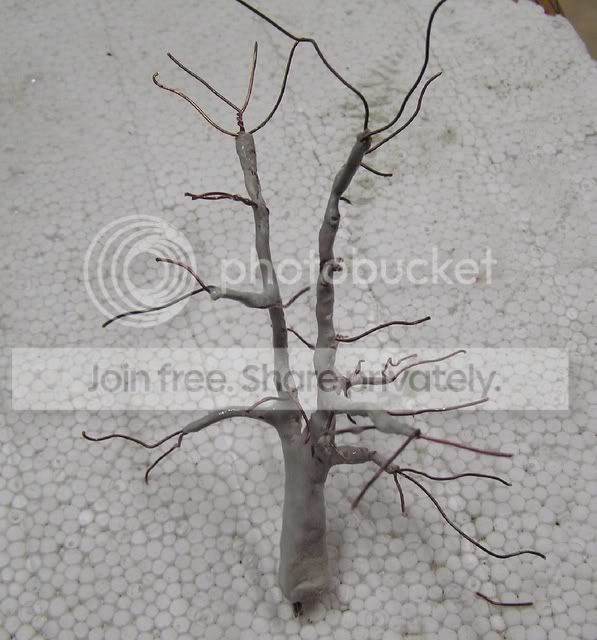
When the glue is dry I paint the trunk and branches with acrylics. Something dark, greyish-brown. I never paint them just brown. I use thin paint so the near-white of the DAS shows through for variety.
Next I add clumps of pre-painted coconut fibres. Just grab some, tease it out lengthwise, and pinch or twist one end to help it look as if the twigs are radiating outwards, and glue in place. Snip through any looped fibres.

Tear the foliage mat into small pieces and test on the tree before glueing. I tried to add the foliage in layers, without being too regimented, and I left plenty of gaps.
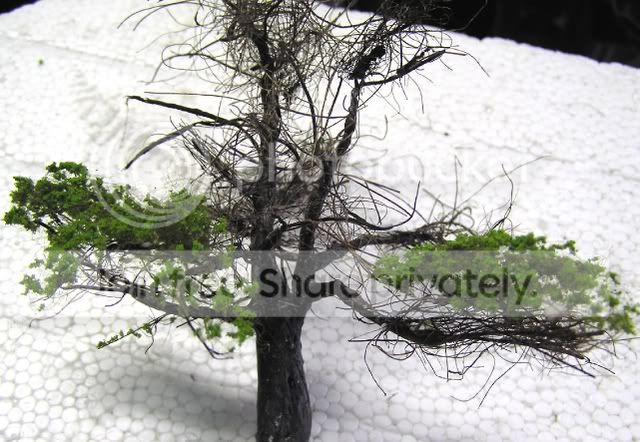
Here's the finished tree on my layout. After I glued it in place I used DAS clay to make some roots for it, and painted them to match the trunk.


Posted

Full Member
Is the copper wire you use 'reclaimed' from electrical cable, or do you have another source?
Perry
Due to cutbacks, the light at the end of the tunnel has been switched off.

Posted
Full Member
That is a very realistic tree. Excellent results.
Novice
Posted
Guest user
The wire's from stripped electrical cable. Sorry I couldn't say what gauge it is - wouldn't have a clue. The strands are about 1mm thick.
Mike
Posted
Guest user
Thanks for adding the thread to our growing "how to" collection.
Posted
Inactive Member
Ken
'It don't mean a thing if it ain't got that Swing'
Posted

Full Member

Wayne
Posted

Inactive Member
I was going to ask for this thread to be put back because when I saw it for the first time on the old forum I was bowled over. I even bought some DAS clay when I went back to UK last time ready for when I got round to making trees. I have never seen more realistic trees - fantastic. :D :D
Les
Devon Junction
Kernow Junction
Kernow Junction
Posted
Guest user
The DAS responds well to a bit of gouging and scoring if you want bark texture, though I rarely do much of that.
Mike
1 guest and 0 members have just viewed this.