
The Weston, Clevedon & Portishead Railway Company
Posted
Inactive Member
Now to some fun building Coaches - Ratio GWR Kit Bashing
Hi Colin,I just happen to have a surplus copy of Peter Strange's book. If interested please let me know by PM. It is in excellent condition.


Posted
Full Member
Somehow I had started off in the wrong direction with my paint shade for the WCPR stock, selecting a grey similar to GWR goods wagons but a revisit to P Strange's text / illustrations indicated that a lighter grey was needed. Some enhancement of his photos confirmed this and that corner braces, door hardware were in a darker shade.
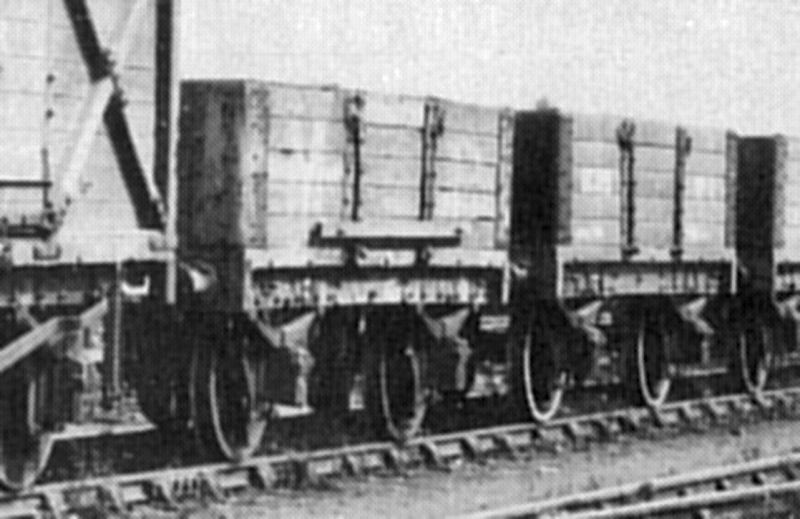
Reproduced from the out of print book “Weston, Clevedon & Portishead Railway", by Peter Strange ISBN 0906294 19 3 Published 1989 by Twelveheads Press, with the approval of the publisher.
Also visible in this photo at Swindon from 1940 after the Railway's closure (see post #9 for full image), the old MR Insignia on the first wagon.
I got confirmation by revisiting the work of two separate modellers of WCPR. Their work feature mostly locos and coaching stock but lurking among their photos is the occasional wagon, sporting suitable grey shades.
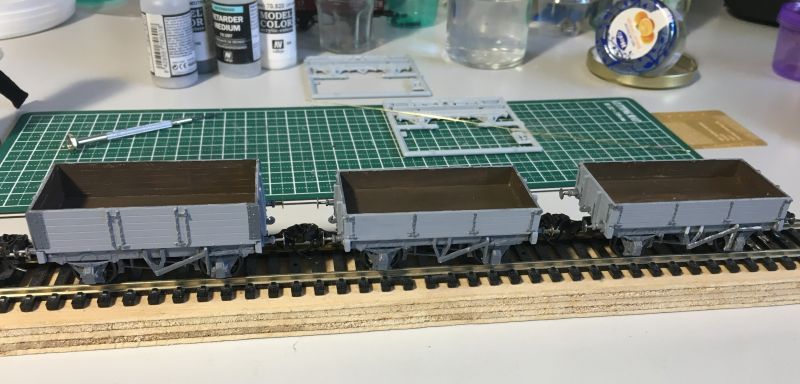
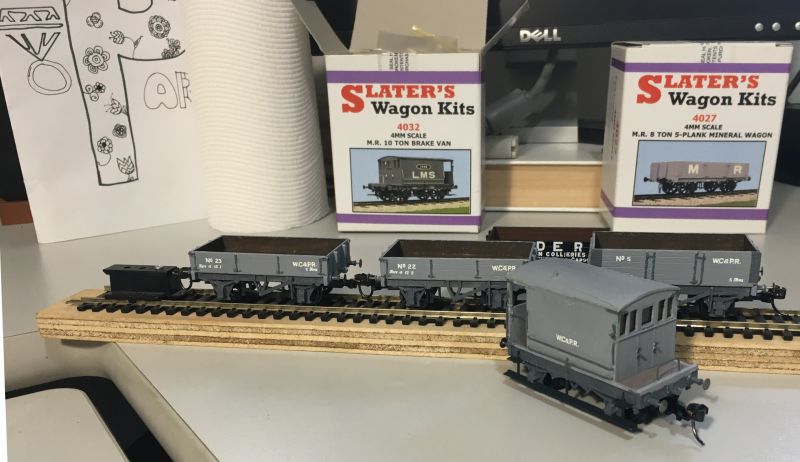
The wagons now are nearing completion, shown here needing just final corrective touching up before sealing and applying transfers.
 Last edit: by Colin W
Posted
Full Member
The final kit from my Slater's MR purchases is this pre-1900 10 Ton Brake. The various photo resources available include just one van that I'm aware of, other than the one which ended up at the WC&PR but that is very helpful.
Modellers must like this van because Slater's have reintroduced it after their business interruption of a few years ago. They also offer a rather pricey 'O' gauge Polyurethane model, highly detailed and fine looking, so the documentation and its photos have been helpful resources.
Finally, from the same P Strange WCPR photo (post #9) which supplied my wagon close ups, I extracted and enhanced this shot of the Brake Van after decommissioning (1940). Helpful because a lot of the MR era fittings can still be spotted, albeit worse for wear.

Reproduced from the out of print book “Weston, Clevedon & Portishead Railway", by Peter Strange ISBN 0906294 19 3 Published 1989 by Twelveheads Press, with the approval of the publisher.
With these resources to hand the kit was assembled, not without some tricky alignment problems which I'm not convinced were caused by me, as I got the main bodywork box dead square and of correct width only to find a mismatch with the floor insert. Having fixed this as best I could, I've moved on to detailing. All the handrails were moldings on the outside panels of the kit. These were carefully carved off and brass 0.5mm replacements installed. Those and the initial batch of lamp irons are shown in the attached photos. (The temporary black tacked brass strip is there to aid in fixing the panel mounted rear lamp irons, this is a van of many irons, 3 at the rear, 4 on the sides and 2 on the open front end.)
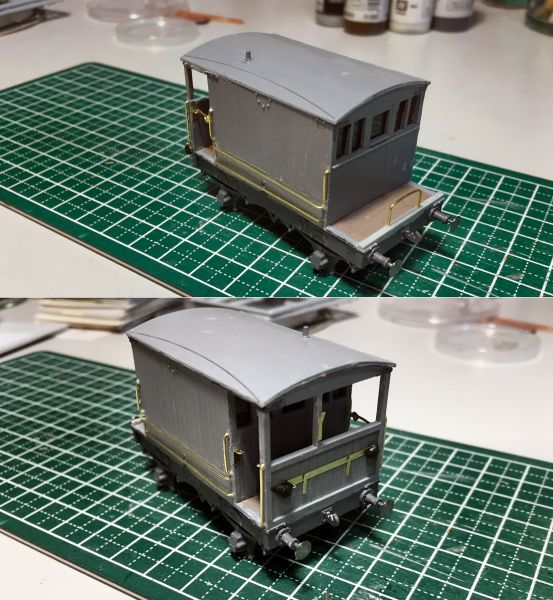
MR eventually removed the open end side lamp irons which can still be seen on the WCPR example, dating the sale to sometime after 1910, much the same period as the wagons transferred to WCPR ownership.
Last edit: by Colin W
Posted
Full Member
"I got confirmation by revisiting the work of two separate modellers of WCPR. Their work feature mostly locos and coaching stock but lurking among their photos is the occasional wagon, sporting suitable grey shades."
The wagons look great Colin but the quote above makes me wonder as to the accuracy of the paint job done by the other two modellers. How do you know that they used the correct shade of grey?
Terry
Last edit: by spurno
Posted
Full Member
Presumably, that end faced rearwards so that if the guard fell off, he wasn't run over by his own wagon …………. :hmm
I too wondered how you decided on the grey shade from a B&W photo ……………………. :roll: :roll:
On Edit - I see on the photo, the open end is indeed facing rearwards ………………… ;-)
'Petermac
Posted
Full Member
Hi Terry,[user=2170]Colin W[/user] wrote:
"I got confirmation by revisiting the work of two separate modellers of WCPR. Their work feature mostly locos and coaching stock but lurking among their photos is the occasional wagon, sporting suitable grey shades."
The wagons look great Colin but the quote above makes me wonder as to the accuracy of the paint job done by the other two modellers. How do you know that they used the correct shade of grey?
Terry
A good point. One of the modellers in question is closely involved with the WC&PR Group located in Somerset and his models have featured at shows and presentations of the WC&PR group. I figure if he hasn't got an accurate shade then no-one will have.
I don't have access to the research and resources they have over there. From the various photos they've shared and as available to me from P Strange's book it's not possible to be definitive, the images may have been overexposed or the prints themselves may have changed. Strange notes in his text that the shade is "Light Grey" and looking across the range of photos which I have I can see the typical shade is of considerably higher "lightness" than GWR wagon grey of the era.
I have one photo, extracted from a video in which wagon and coach ends at Clevedon yards are directly lit and done some analysis to quantify the lightness issue. The two tone grey of a 5 plank wagon is clearly visible and image analysis shows that the corner braces have roughly half the lightness of the panel.

# Frame from the BBC 1988 film "The Seaside Railways" - The WC&PR
There is surely no topic more likely to fuel long debate between modellers than the correct shade for xxxx. Hornby GWR Green is a perennial, SR green a current favourite over on the Rails Terrier Topic. Even something as basic as GWR Wagon grey which ex-works was a very dark grey, only 13% lighter than Black has RTR manufactures supplying notably different shades on their wagons.
I've given the task in hand my best effort and have enjoyed all the detective work along the way.
Posted
Full Member
Hi Peter,I too wondered how you decided on the grey shade from a B&W photo ……………………. :roll: :roll:
My previous post gives you a view on how I assessed relative "lightness" for a specific image. It is easier when working with Greys, images can first be converted to "greyscale" to remove any colour cast.
Then the Histogram shows all the selected image components from 0% lightness i.e. pure black to 100% white in a small selected area. The first histogram of the corner brace shows a mean lightness of 38/255 (15%) whereas the panel is 73/255 (29%). These are not absolute values since I've no frame of reference for the photo but the relative data is a helpful guide.
When you overlay the issue of fading then who knows, My two tone scheme has the relative grey shades in the right ballpark to my eye which is the best I can do.
Posted
Inactive Member
Posted
Full Member
I will never question your choice again. There's no way I'd have gone to that level of analysis myself so I heartily congratulate you and you Somerset team. :pathead
'Petermac
Posted
Full Member
Fortunately for us railway modellers, this constant weathering is our savoir, as provided the model is well weathered, the colour cannot be disputed!
Bill
Last edit: by Longchap
At 6'4'', Bill is a tall chap, then again, when horizontal he is rather long and people often used to trip over him! . . . and so a nickname was born :)
Posted
Full Member
Color (or more strictly with grey lack of color) is always dodgy with b/w photographs. Especially old ones. I stopped worrying about grey, whatever shade is in the rattle can is going to be correct. Too dark? Out with the white weathering powder. Too light? Out with the black.
I would have thought they rarely got painted (if at all). Still had the MR lettering from the photograoh. Each batch of MR grey reportedly mixed from lamp black and white lead, no two the same!
Nigel
©Nigel C. Phillips
Posted
Full Member
Thanks everyone for the feedback. We're in agreement regarding the futility of matching the absolute lightness of greys with something which is poorly recorded and almost certainly was constantly changing. However, the one thing clear from a variety of photos is the two tone light/ darker grey paint scheme which I've at least some feel for now.
The issue of the "MR" insignia on the 5 plank wagon - 1940 photo is an interesting one because a variety of photos from different times show wagons all clearly and neatly painted up in WC&PR colours. One of these images, kindly shared by Col Stephens of this parish, shows #5, 6 and 21, the last being a 5 plank wagon having a timber cross brace on the door (not MR standard issue).
All but 3 wagons were acquired after 1907 (timeline unknown). The rapid increase in wagon numbers aligns with Col. Stephens taking charge in 1911 and subsequent new investment in the shape of a Wharf on the River Yeo (1913) which allowed more freight, viz. coal from S Wales to be brought in, mostly for use by the Railway. In the positive environment of these initiatives it's hard to imagine anything other than a neatly turned out fleet of wagons as more than one photo on Yeo wharf attests.
Given this background, a wagon in 1940 showing residual MR but not WCPR insignia becomes more than a little puzzling. Most of the wagons were condemned at closure in 1940 and only the best transferred to Swindon, only one of which (mystery MR) was sporting the door brace seen earlier on #21, if so it was earlier painted in full WCPR "colours".
The anticipated arrival of P Strange's book (thx here to 60019Bittern) may shed more light on this "divertimento" in light railway history.
Last edit: by Colin W
Posted
Full Member
I've had a solid run at finishing off this job while I patiently watch the days count down to my next X-Ray. Just 9 more now to go.
All three ex-MR wagons and Brake Van are nearing completion just needing finishing touches after the addition of decals to all. As with the "Beetle" Prize Cattle Van (W-H topic) I'm using HMRS 'Pressfix', Sheet 11 GWR Goods Vehicle Insignia. It's fortunate that this sheet has plenty of the key letters I needed in 2mm; its only shortcoming, no ampersands but as W.C&P.R. needs two per vehicle that was always going to be the biggest hurdle. I've one excellent close up reference photo, all I needed to get the correct setups and here they are:
Aside from "Tare" and "Tons", each item had to be assembled one character at a time, "well that's character building for you" SWMBO quipped. "&" was solved by using a slightly off vertical "8" and adding a down arm. Adding a smaller upturned arm was at the boundary of fiddliness and deemed unnecessary. The tilting and down arm tricks the eye (mine anyway) into sensing the desired character at normal viewing distance. This is best of the batch

WCPR wagon modelling has at least one more chapter to come but that's still at the planning stage as some very interesting research has turned up some surprising results.
Posted
Full Member
Modellers have tended to focus on modelling the Locos and Passenger stock of the Railway so the hurdle was probably a very low one. I set out to capture a representative and accurate collection of the Goods stock and here are my nearly complete 4 wagons + Brake Van behind #4. There will be further additions, mostly PO stock which was often found tacked on to any convenient departing train, goods or passenger.
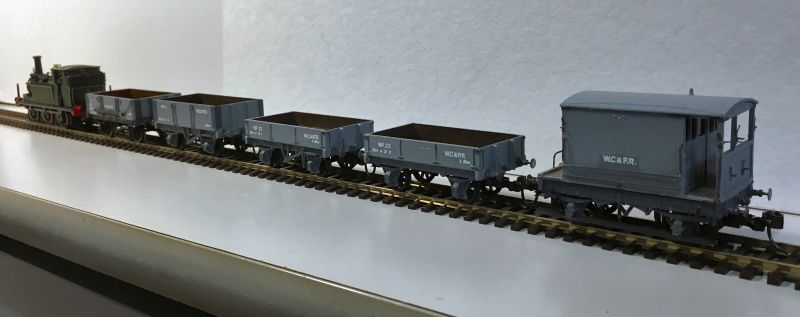

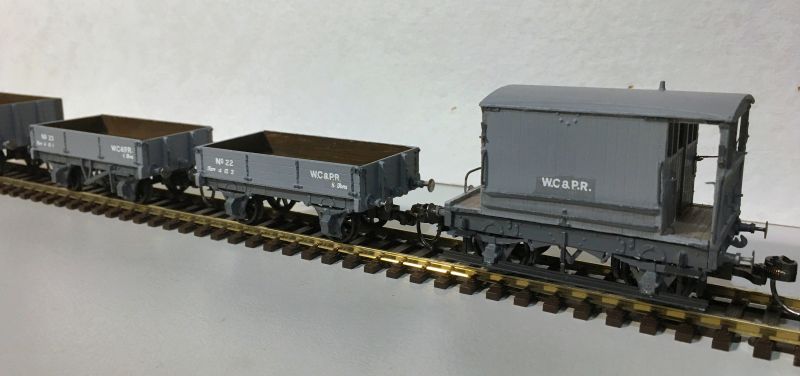
More details to follow.
Posted
Full Member
Did the W,C&P have and vans or were they all open wagons ? A couple of 12 ton vans would look good tagged on to that train - or indeed, just a couple of vans and the brake might make an appropriate train for the struggling railway. :roll:
'Petermac
Posted
Full Member
They had only one, an ex-NER covered Van. A rather odd affair from the 1880s which requires either a white-metal kit build or something done from complete scratch.
So far, I've only the one photo showing this van, the one with all the "remaindered" stock at Swindon after the Railway's closure. My limited photos of Goods traffic show mainly mixed trains with open wagons, WC&PR and PO stock plus one intriguing one I'm still working on identifying!
There is a report somewhere of one of the Terriers pulling up to 30 wagons! That would be the entire stock + a few PO thrown in for good measure and surely there must have been considerable Goods traffic, just not considered photo-worthy enough perhaps?

Colin
Last edit: by Colin W
Posted
Full Member
Slapping a plank across wagons seems to have been a WCPR special technique, seen also on Wagon #21 and captured in my model in the previous posts - "A Right Proper Job" as is said in those parts!
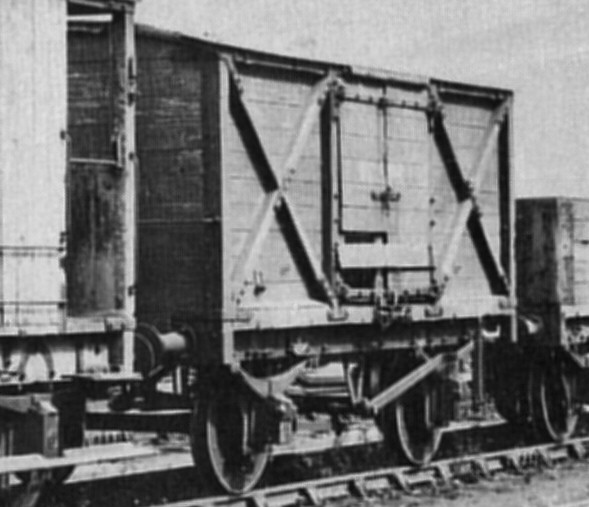
Extracted and Reproduced from the out of print “Weston, Clevedon & Portishead Railway", by Peter Strange ISBN 0906294 19 3 Published 1989 by Twelveheads Press, with the approval of the publisher.
Any ideas about how to go about building one will be welcomed, I'm not planning to go down the White-metal kit route for what would be a pure one-off job.
Last edit: by Colin W
Posted
Full Member
Three, possibly four other wagons have been identified from the various available photos.
1) #21 - I'll add the photo of this when I can provide a source.
For now it suffices to say that my model of #21 shown earlier has been build by converting a RTR PO wagon of the era. This follows on from valuable input from Stephen Lea who is a keen student of wagons in general and MR in particular. It was Stephen who guided me thru the 3 and 5 plank MR kit builds getting them representative of the wagons MR on sold to WC&PR. Stephen pointed out that #21 could not be either MR (cross braces) or GWR (no Angled iron on door sides) and was likely to be of PO origins.
2) GWR 5 plank wagon. This photo (rear wagon) from late 1937 clearly shows the GWR angle iron door supports missing on #21. The Insignia GW appears in the correct location. It seems unlikely this will have ever gained a WCPR insignia in the troubled last two years of the Railway

Reproduced from the out of print book “Weston, Clevedon & Portishead Railway", by Peter Strange ISBN 0906294 19 3 Published 1989 by Twelveheads Press, with the approval of the publisher.
3) Is a rectangular Oil Tank. Apparently PO Clevedon Gas Works. in front of the GW wagon
4) An ex-MR 5-Plank wagon which might never have received a WCPR insignia. It appears in very early photos with fresh "M R" and one with MR clearly visible is among the Swindon remaindered stock.
Last edit: by Colin W
Posted
Full Member
WC&PR had a diverse range of Coaches during its forty-three years of operations but the best known are #15-18 which were the main operating stock in the final years. The first three of these were originally built for the LSWR by Metropolitan Carriage and Wagon. Two (#15, #17) were 24' 6" Saloons, #15 being a Brake Saloon, dating from 1869 (Beattie) and I have a suitable diagram for these. The last #16 was a LSWR 30' Five Compartment all Third from 1879-85 of standard MCW design.
These four wheeled coaches fell out of use by the LSWR by 1905 and were on sold to Col. Stephens for use on his railways. #15-17 didn't go straight to the WC&PR but were reunited there in 1925 when they became the main Passenger stock for use until 1940, often operated as a close coupled triplet.
Unusually, the WC&PR had 1st and 2nd Class but no 3rd and it appears to have retained the comfort standard of the LSWR 2nd Class in its Saloons. It is possible that #16 retained the comfort level of its 3rd class background being upgraded to 2nd in name only? Peter Strange notes the coaches were lit by Electricity (from dynamo in #15), steam heated and gave a comfortable ride (no doubt aided by the legendary slowness of operation!)
It is these three interesting coaches which I'm in the process of building from Ratio GWR Four Wheeler Kits.
Coach #18 is recorded here for reference; it was an ex-Taff Vale /GWR and a was an unusual 26' four wheeled two compartment Brake 2nd. It might become "A Coach of Interest" once the first three are complete.
To aid my modelling I am fortunate the have some excellent detailed photos of #15-17 as well as the LSWR diagrams even if #15/17 were extensively rebuilt in 1888 after some 20 years of use.
Posted
Full Member
WC&PR #15 and #17 both being 24' Saloons present similar challenges, requiring resizing and mixing / matching parts from suitable kits as well as creating the larger Saloon windows.
For the novice tackling projects of this sort there's a lot of useful information about the kits, prototypes and construction in an article by Mikkel at http://www.gwr.org.uk/proratio.html
and MikeOxon here Back Dating Ratio GWR Coaches
as well as Nick's(Woody) and LongChap's Clifton Downs projects on YMRC.
With a good photo of #15 to hand, suitable parts from Ratio 612 (4 Compartment Composite) and Ratio 613 (2 Compartment 3rd Guard Brake) were identified
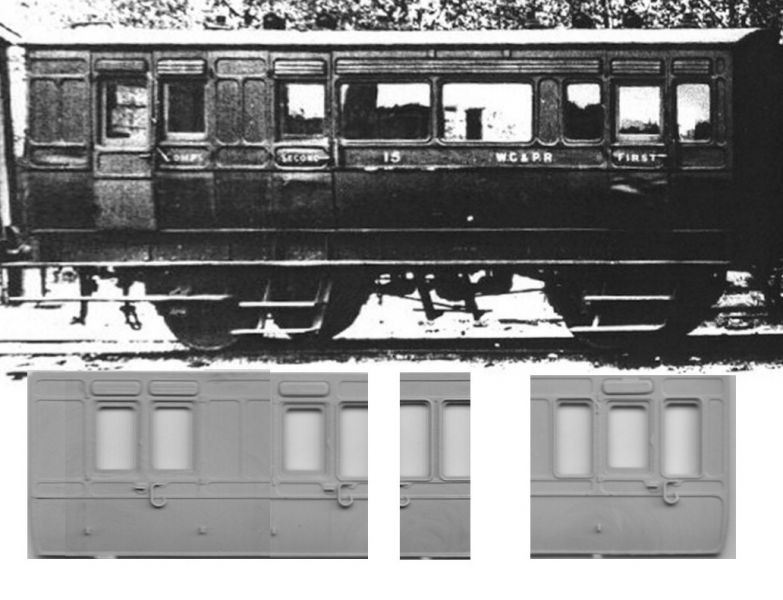
Photo reproduced with the Permission of Weston-super-Mare Library and the WC&PR Group
I decided it would be easiest to organise alignment if the Saloon windows mid sections were assembled by using a solid coach segment then cutting back once everything was together.
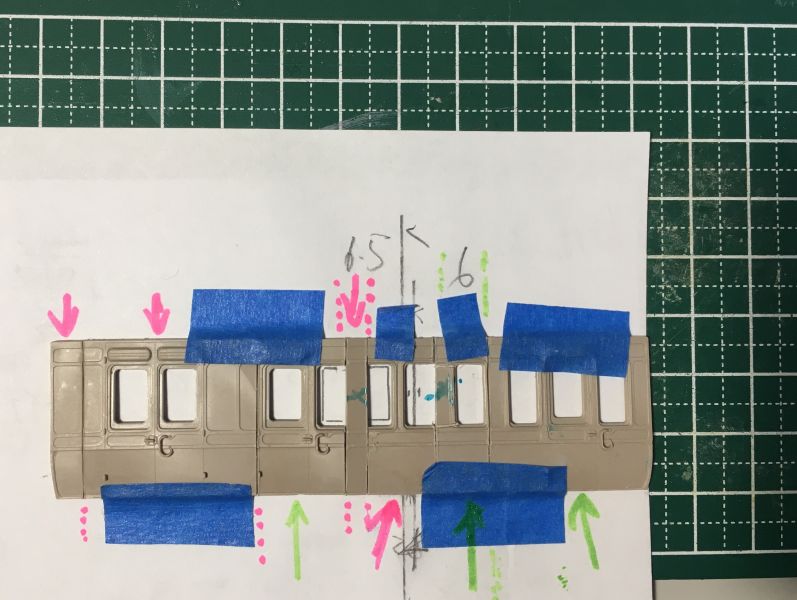
This photo shows the RHS components before final gluing; rose markers are elements from Ratio 613, green from Ratio 612. In total 7 segments make up the approx 10cm side. As can been seen in this photo after with careful cutting, the parts from 613 tended to warp slightly even with firm clamping to a supporting back strip. This was later addressed with Milliput and sanding back.
# For anyone looking to buy these kits - recently they've been moved by PECO into the Parkside Models portfolio of products, repackaged with PC coding, same numbering. I'll stick with the Ratio Kit numbers because these were what I got.
Last edit: by Colin W
1 guest and 0 members have just viewed this.