
Penhayle Bay
Posted

Full Member
A popular layout back on YMRC
Today's final public running session theme was "Anything Goes". It certainly did. Rule 1 was stretched to the limit. A selection of still pictures shows some of the action. There are also video clips which take longer to upload and process.Nothing very unusual about a Beattie well-tank at Ponsangwyn shed except that the gantry crane isn't usually there. The shot has been set up to resemble views captured at Wadebridge shed in the final days of the well-tanks.

Likewise there's nothing particularly unusual about the class 03 shunter parked beside the goods shed other than the fact of it not being a very frequent visitor

Two GWR pannier tanks prepare to depart with the milk train. The lead loco is one of those sold to London Transport and wears its smart maroon livery

Up at Treheligan station the St. Agnes branch was operated for a time by a Southern Region 2EPB unit which would normally require third-rail electric power.

Very unexpected was the use of an engineer's trolley to haul a parcel working. Even more out of place was the Australian train waiting at Carreglyp Dries with a rake of open bogies wagons led by a GM-class loco in the short-lived Great Northern livery (no link to the former British company of that name and rather surprising because they were based in Melbourne - the most southerly mainland city)

On the main line another Aussie loco, a 1952-built Victorian A-class, leads a rake of elderly carriages over Darras Viaduct. Loco and coaches are owned by friends and were visiting for the day.

A star performer was Stephenson's Rocket also brought along by a friend. The loco is a plastic Airfix kit which has been skilfully built to run freely and is pushed by a Black Beetle motor mounted beneath the carriage which is a Hornby item.

Rocket was unable to complete a circuit of the layout owing to issues with structure gauging!!! It did however manage several trips up and down parts of the layout without such problems.

Perhaps the most unexpected visitor to run - and it ran perfectly - was a working model of a Melbourne W5-class tram. Normally powered from the overhead this too must have been draining its batteries to run on a two-rail system!

Finally back at Ponsangwyn the West Country which spent several hours working hard on a freight train which will feature in the videos rested beside a class 22 and the well-tanks. Somehow the gantry crane has managed to vanish and the shed is back to relative normality.


Posted
Full Member
Firstly the daytime train on the St. Agnes branch which was formed of a pair of ex-LSWR coaches and worked by no fewer than three locomotives. With two of the Beattie well-tanks in the yard the third was on the train with an A1X Terrier coupled inside. At the other end was an Isle of Wight O2, No. 16 "Ventnor". Not an everyday sight on the mainland let alone in "Cornwall"

As mentioned in the post above with the stills one of the Bulleid light Pacific fleet, WEst Country 34041 "Wilton" was assigned the freight which had been brought in the night before by the Garratt. The Bulleid worked hard and ran for a couple of hours sometimes coping with the gradients - if only just - but here requiring a rear-end shove after stalling on Penhayle Bay's 1:50 reverse-curves.

One of the class 22s masquerades as its Scottish class 21 sister running in tandem (though not in multiple due to incompatible control systems) with a Scottish Region class 17 Clayton. This working was christened the "McMilk" train.

A visiting class 25 and a mixed freight all of which looked suspiciously clean by Penhayle's standards!

Another most unexpected combination occurred when this Chinese steam locomotive was coupled to the old Australian carriage set and ran a few circuits.

My own all-Lima train glimpsed above in the sidings took quite a run at the bank when let loose on the main line. For a loco which hasn't turned a wheel in 12 years this ran rather well. Both loco and wagons are Australian.

That remarkable Airfix kit Rocket seen in action and pushed by the Black Beetle-powered coach. To build that kit so well and able to run freely on a layout required skill indeed. This was also something of a crossed-finger moment as neither had ever been run before.

Visiting Crompton 33111 races downhill with the direct mails from Llanbourne, a friend's layout, to west Cornwall and is passed by a pair of Penhayle's own 37s working hard uphill with a heavy train of china clay.

The Melbourne tram in action. Despite the protruding step-boards she managed to run perfectly without fouling any of the lineside structures. I'm not sure what the power unit is but it's not exactly quiet.

This class 25 was another visitor from Llanbourne and had charge of a mixed rake of engineer's hoppers some of which are kit builds.

The two GWR pannier-tanks took over the milk train from the Scottish Region diesels and are seen in a late-night movement coming off the down loop towards Treheligan station. This train usually has a GWR Hawksworth brake van on the rear but for this occasion featured an LMS design brake instead

And finally the train which started it all in more ways than one. The Powerline coaches and generic "Bulldog" locomotive are intended to resemble regional passenger trains used in the State of Victoria. Some of the "S-cars" remain in traffic to this day though the tangerine livery is long gone. This set, with an oval of track, was presented to me a few weeks after we moved to the house 14 years ago and ran around the dining table on an oval of track for want of anywhere else. "Anywhere else" became Penhayle Bay. The formal opening of the layout featured a shiny new Bulleid light Pacific with a ribbon to be broken upon its departure. While the opening speeches were in progress I slyly ran the orange train in from the other direction, unseen until the last moment, whence it broke the tape ahead of the Bulleid while the onlookers gasped in astonishment. The S-set has seen very little use since the layout was built but will be kept on as historically significant.

So the final open-house at Penhayle Bay has taken place. It isn't quite the end. The originally-advertised closure date of 17th April, Easter Monday, will be honoured for the benefit of those taking their holidays by train. In the tradition of these things a number of "Farewell" specials is due over the next few days. And the very last trains will be recorded for posterity before this topic is then closed.
 Last edit: by Gwiwer
Posted
Full Member
The demolition of some buildings at Treheligan have given it a rather bare appearance but have opened up a better view of the branch bay platform. The DMU pair seen in some photos above remained on duty first thing today

A class 52 Western gets the road up from Ponsangwyn to the Down Loop alongside the main line

It wasn't too long before the first of the day's specials appeared. A Pullman dining train led by an as-built West Country light Pacific

The Southdown coach in the parking area is also a visitor and is down from Portsmouth

The 2-car DMU returned from its trip to St. Agnes and crossed to the Up Main rather than retiring to the bay platform

Its place was taken by a single class 153 car in black Cornish promotional livery. Would this be big enough for the holiday crowds on this seaside branch?

Shortly afterwards an enthusiasts' charter formed of a 6-car DMU also crossed over to take the branch for a farewell trip.

The special ran through Treheligan station having crossed from Down to Up tracks and then onto the branch.

One last special was a 2-car class 171 diesel unit in Southern livery and a long way from its usual home on the Brighton - Ashford "Marshlink" line

The Western handled the china clay train with the usual ease seen here coasting down through the woods

With no turntable available for the West Country the steam special was returned by an S15 which seems to be having too easy a time of it on Penhayle Bay's 1:37 bank

Definitely not enough smoke for the task at hand. Something must be amiss

What ever was amiss at the front all the work was being done by a class 66 at the back!

Yinging its way around the curves and up the hill the "shed" pushed the ailing steamer clear as quickly as it could

The Bulleid returned in the block behind running tender-first

The railtour also powered up the hill into the lowering sun and bade farewell to the surf beach and sand dunes of Penhayle Bay

And the branch 2-car DMU set also left for up-country never to be seen again in these parts but leaving a lasting impression in the sun's glow

For at least one whole generation nothing said "Cornwall" louder than a grimy Western leading a rake of blue-hooded china clay wagons. The train exits the Down Loop, snakes beneath Treheligan station bridge in a move always popular with visitors, and enters the Down Platform Loop.

And finally the clays ease back for the downhill approach and reverse-curves at Penhayle Bay, disappearing into the distance as the surf rolls in far below, the gulls cry and the distant sound of voices from beach and clifftops merge with the rustle of evening air.

The last trains run tomorrow. Some changes have already taken place. One final picture-post will record their departure and the final "ring out" of the signalmen as the line closes for ever.
Posted
Site staff


Regards
Alan
Born beside the mighty GWR.
Alan
Born beside the mighty GWR.
Posted
Full Member
In the morning there was a steady trickle of passengers some of whom seemed shocked at the state Treheligan station had been left in

With the down tracks closed and the loop lifted most signals on the down side were marked out of use; only the route to the right across the diamond into the up platform remained available

The footbridge remained but was fenced off on the up side to prevent unauthorised access to the now-closed down side.

The hoods make their way slowly across the diamond to loop through the up platform …..

….. before regaining the down road at the far end of the station. As can be seen this has always been a permitted and signalled move.

The wreckers had certainly been at work; more signals out of use pending removal with rusted and torn up tracks.

The clays ease over the western end crossover to regain double track

For its last day of operation the St. Agnes branch was worked by the black-liveried Cornish promotional class 153 car, passing the glimpse of angry seas one last time

And giving some idea of just how steep this gradient is. The branch was an afterthought and the need to have it clear the fiddle yard access tracks hadn't been thought through properly when the gradient went it.

Waiting for the board to drop and move on into the platform; the weathering applied to the 153 is apparent in this light.

There were still a few passengers for the branch trains right to the end.

Most down trains were replaced by buses in order to have all rolling stock cleared from the end of the line by closure; there's always one idiot who thinks bus stops are free car parks.

The final collection of vans was in the hands of a red-livery class 47

The reds of the train stood out against the sand dunes and sea of Penhayle Bay

One last time a blue Western led the hoods above the beach, around the reverse-curves and through Penhayle Bay

The final train from Ponsangwyn, where the shed was already deserted, was the empty milk tanks off to maybe a new working or perhaps a scrapyard. Warship 812 "Royal Naval Reserve" was in charge.

Surprisingly the yard lighting was still working which allowed the weathering and the cast nameplate to be shown off. It's actually a Fox etch.

A single class 37 was rostered to work the final up clay tanks, seen here on a downhill stretch across Darras Viaduct but no doubt providing a fair amount of thrash when working uphill. This train is usually a two-engine load.

A group of mourners had gathered at Penhayle Bay later in the day as the class 22 struggles gamely with a long freight against a steep climb. Again the need to remove motive power before the end resulted in an under-powered train instead of a double-header

The very last down train of all pulls away from Treheligan …..

….. only to be brought to an ignominious halt at the section signal. Perhaps someone was having a laugh as there hadn't been anything in front for hours.

With the road cleared there was one last opportunity to frame a train beneath Church Lane bridge amid the gorse and greenery

The divisional inspection saloon conveyed some senior managers over the lines about to be closed including making a trip to St. Agnes worked by 66511, here seen pushing the saloon back to the main line.

The photographers who have patiently waited for and recorded trains from the hillside at Darras all these years finally moved down to Treheligan station to record the very last trains. The maroon Western is back from Penzance for the final time. It's best not to ask how those lads got access to the closed platform!

Even into the evening there were still a few passengers about though the numbers had been dwindling all day.

The inspection saloon passes through Penhayle Bay where the gradient post shows the climb steepening from 1:50 to 1:37

Towards nightfall the very last shunt of clay wagons took place at Carreglyb; the duty 08 draws back one half of the train from No.2 (loading) Siding

towards Treheligan station

This half is then propelled forwards to be joined to the other half n No.1 Siding. Weathering work again in evidence on the Hornby shunter and Bachmann wagon.

The shunter withdraws from the section; until recently it would have trundled off to the loco run-round loop alongside the St. Agnes bay platform but with that also now closed the move was simply to the branch itself and sit outside the signal to release the block on the main line

The final departure from the clay dries was thus ready and led away by a green Warship

One last time a string of short wheelbase clay wagons was seen threading the curves above Penhayle Bay

Onwards and upwards to Nansglaw Tunnel

The shunter followed as soon as the road was clear.

Not one bus on the bridge but two. Just in case a crowd turned out for the very end. But both seem to be empty.

The St. Agnes unit returned up-country pausing in front of the mourners

One last loco-hauled train came up through Cornwall featuring a large-logo blue class 50 in a scene which typified the Cornish main line for some years

The final loco-hauled working on the line

Honour of being the very last train fell to a humble 2-car DMU calling at all stations to Exeter and "sweeping up" the very last passengers from Penhayle Bay. At least it seems to be decently loaded.

The final station stop; the last train from Penhayle Bay

Waved away by a couple of saddened locals

Posted
Full Member
Featuring a trio of typically Cornish trains including the very last to run on the Penhayle Bay Railway.
Thank you, one and all, for the interest, support, friendship, comments, learning and everything which this layout has brought. With well over 10,000 Facebook followers in addition to being featured on three modelling forums it has proved far more popular and enduring than I ever expected.
Life moves on. I am moving on. A new project will emerge in the future. I hope you will be around to share that with me too.
Posted

Full Member
Well deserved applause for a cracking layout
:Happy :Happy :Happy :Happy
Cheers
Andy
Andy
Posted
Full Member
All the best for the future
Colin
Posted
Full Member
KMRC Newsletter
KMRC - Customer Layouts
Posted
Full Member
Still remains one of my favourite layouts online and one I reference when building mine!
Posted
Full Member
Always try to look on the bright side of life!
Barney
Barney
Posted
Full Member
Few of us are lucky enough to have that sort of space. And few indeed are so fortunate to have had their first-build layout attract the sort of following that Penhayle Bay did. And still does as there remain around 12,000 followers on its Facebook page despite there having been no new posts for quite some time. People are either interested enough to refer back to it at times or simply can't be bothered clicking the "Unfollow" button!
Posted
Full Member
Learning about this topic via Picture of the Month, I posted some comments over there which are better suited to here and so now have been moved………..
Just caught up with all your earlier modelling since it predated my joining here. I can't believe how you managed to set up a functioning outdoors layout here in Melbourne. Do you have any overview photos of the whole layout you could share?
Jeff has commented about the various 4,6 and 8 legged vermin that can wreck havoc with everything and anything, not to mention the extremes of weather. I just untied the "Fort Knox" which is my securely netted pear tree to harvest some ripe nashi pear only to find siberian hamster rat munchings on the occasional high up fruit. Then wee get temps nearing 40C in summer often followed by torrential rain, surely there must have been robust overhead coverings to protect your setting. If transparent didn't it become a greenhouse?
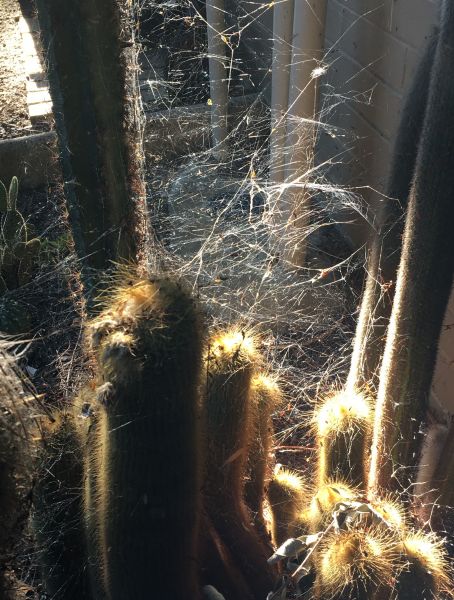
Then I can't imagine point motors, mechanised signals and the like not being adopted as home by some spider among the many in these parts. By way of example I couldn't resist attaching this recently found in a tiny cactus bed, the webs were only brushed down 2-3 weeks earlier but bounced right back with avengance. How many spiders were involved I've no idea but they do trap the mozzies :lol:
Once I even had a small black jumping spider climbing a footbridge on a layout one step / jump at a time. How did you ever manage to keep them at bay?
Colin
Posted
Full Member

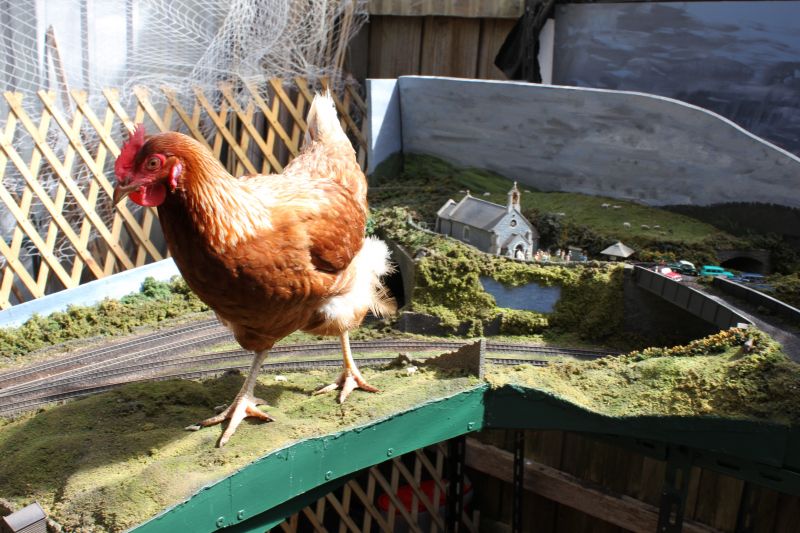
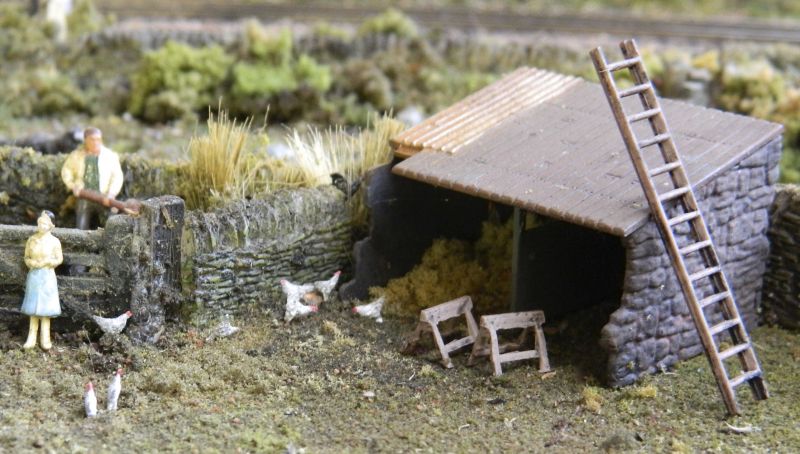
Of course I know Aussies call them "chooks" but whatever! What this also shows is the flexible screen and bird netting used across the open end to discourage intrusions. It was reasonably successful in that very few creatures which could do much harm ever came in that way but if they did (and the occasional bird did get through) they had more trouble getting back out.
There are pictures if you go back through this thread but very few "long shots" as I always had difficulty getting a useable one. The layout was around 15m long and 2.5m wide so long and thin beside the house.
Posted
Full Member
'Petermac
Posted
Full Member
Posted
Full Member
A regular spray with Aerogard seemed to stop most things. I did have a few issues with spider webs (but very seldom saw the spiders themselves) but most were confined to the trees and under-board wiring rather than signals and point motors.I can't imagine point motors, mechanised signals and the like not being adopted as home by some spider
temps nearing 40C in summer often followed by torrential rain, surely there must have been robust overhead coverings to protect your setting. If transparent didn't it become a greenhouse?
It certainly got very hot in summer. The layout was covered by a polycarbonate roof which I extended from the original so as to run the full length of the layout area. It also had a little shade from trees in our and our neighbour's properties. But in summer it reached well over 40C under the roof and unless the north wind was also blowing it could get uncomfortable. The north wind in Melbourne brings very hot, very dry conditions but at least hot, dry moving air feels better than when it's calm.
I used thick polystyrene blocks salvaged from white-goods deliveries over the years to insulate rolling stock stored outside from the heat - and the rain. It worked a treat. I could reliably store trains in the fiddle yard under these movable covers and they wouldn't be at more than 20 - 22C even when the air around was more like 42C. They helped keep the rain off although I managed to prevent most from ever getting in in the first place. A few spots were persistently wet but only one area of board ever rotted out - a small area in the fiddle yard which was adjacent to the garden fence and where the plastic membrane used for waterproofing behind the sky panels was never 100% effective.
The open end (the farm scene if you go back through the pictures) was open to full sun at certain times of day which caused the demise and replacement of the points there a couple of times but no other serious damage. The rails were measured at 57C on at least three occasions. Peco Streamline track withstood the conditions superbly and seldom gave me any problem that I hadn't built in for myself. I had a couple if heat buckles early on but once I left larger expansion gaps at the joiners all was well.
Posted
Full Member
Jeff Lynn,
Amateur layabout, Professional Lurker, Thread hijacker extraordinaire
Amateur layabout, Professional Lurker, Thread hijacker extraordinaire
Posted

Site staff
That chicken is just a tad overscale, Rick. Couldn't you find a smaller one?
Wasnie me, a big boy did it and ran away
"Why did you volunteer ? I didn't Sir, the other three stepped backwards"
"Why did you volunteer ? I didn't Sir, the other three stepped backwards"
Posted
Full Member
We did try to breed them a bit smaller but they kept growingThat chicken is just a tad overscale, Rick. Couldn't you find a smaller one?
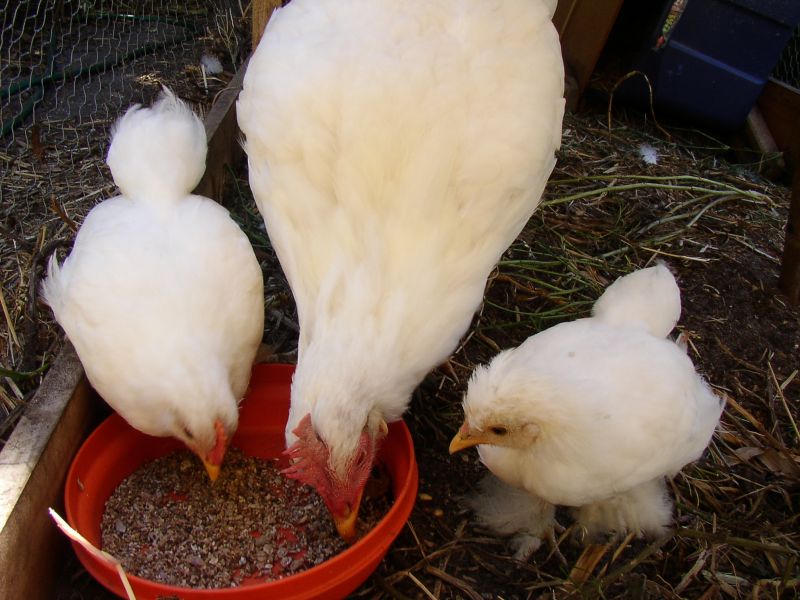
I found some pre-painted metal chickens, though from where now escapes me, but never managed a good photo of them. This is about as good as it got. The pack included an allover scarlet rooster; I wonder if they knew about the Australian fried-chicken franchise called "Red Rooster". :hmm
1 guest and 0 members have just viewed this.