
Granby Junction 1948 N. Wales
Posted

Full Member
GWR/LMS OO Gauge DCC RR&Co
Some more progress on the Scalescene Hotel.Regular readers will recall that the plan is to convert the low relief kit and build a full three dimensional model. When complete, this will form the centre-piece of the square outside Granby Junction
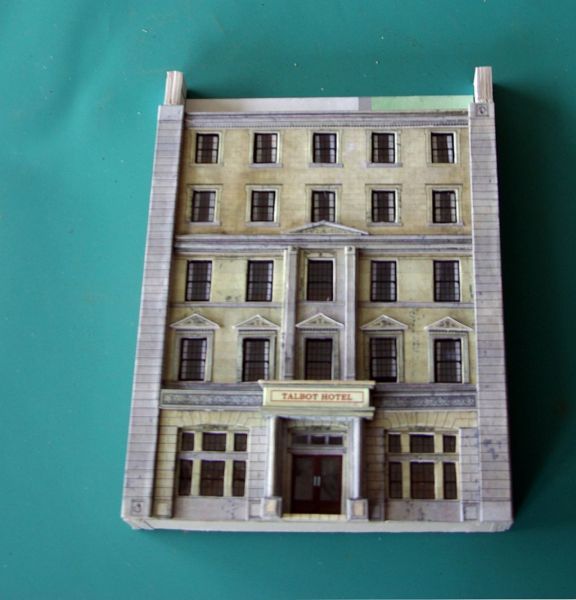
Here is the first module on site in February
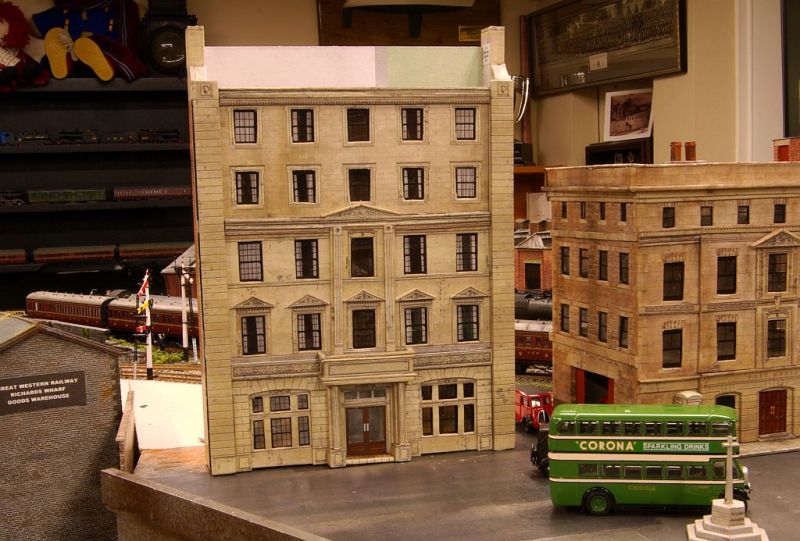
As you can see this is one of the more complex and intricate of John Wiffen's designs. It is certainly quite time consuming. Despite my best intentions I never quite managed to cut card in the morning and run trains in the afternoon. With the layout neglected, once this module was done I took a wee break.
Assorted electrical problems delayed my return to the project but eventually, in August, I completed a second module
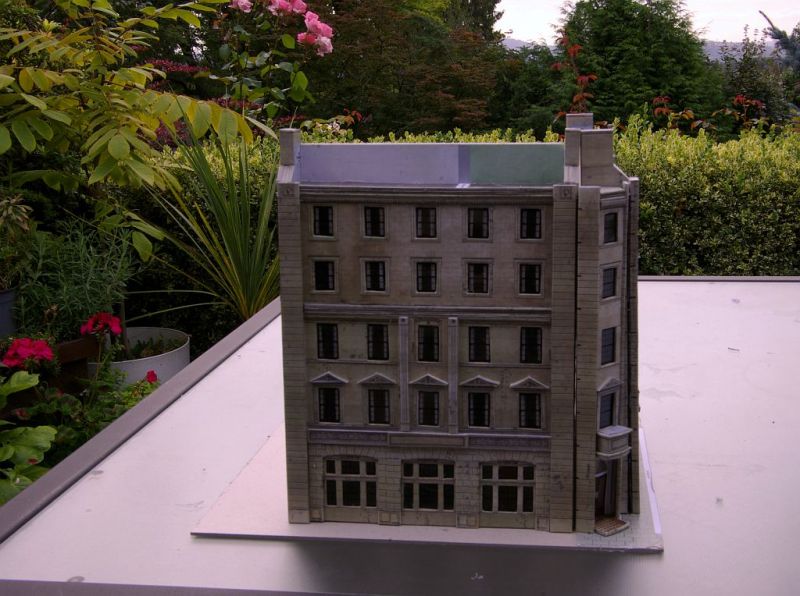
Card modelling with a glass of something cooling can be quite therapeutic in the summer.
You will have noticed that both units are without a roof. The low relief kit is finished off with a neat row of dormer gables………I delayed installing them because I couldnt quite work out how to seamlessly incorporate them into a three dimensional relief. So I took another little break and focussed on getting my new prairies running properly.
With some help from John Wiffen I think I may have solved the roof problem so last week I started on the third and final unit. I had intended to post when the unit was finished but the weather here has been quite wonderful so I couldnt resist taking the units outside for a photo shoot
Here we are in November with unit 3 basking in the fall sunshine.
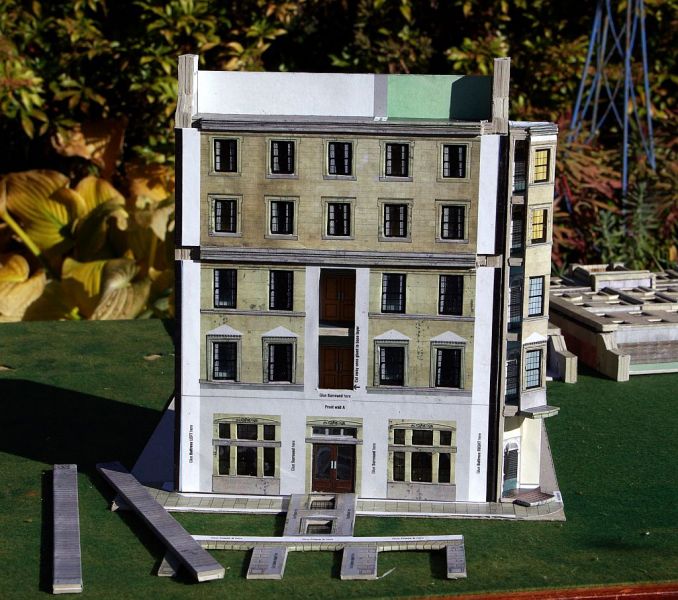
The three units as they will eventually appear in shape of a hollow square
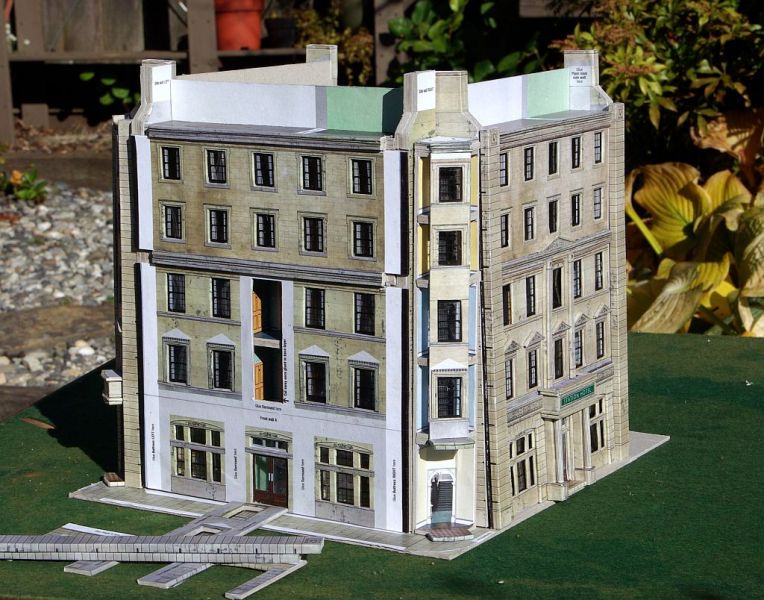
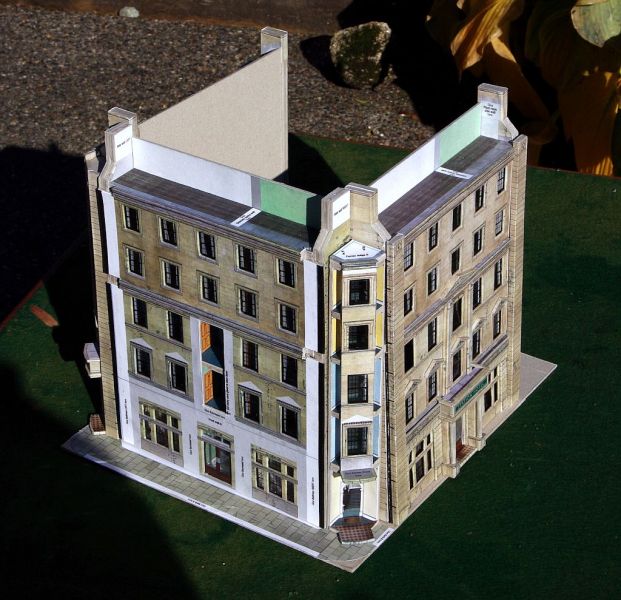
The building will be viewed from both front and back
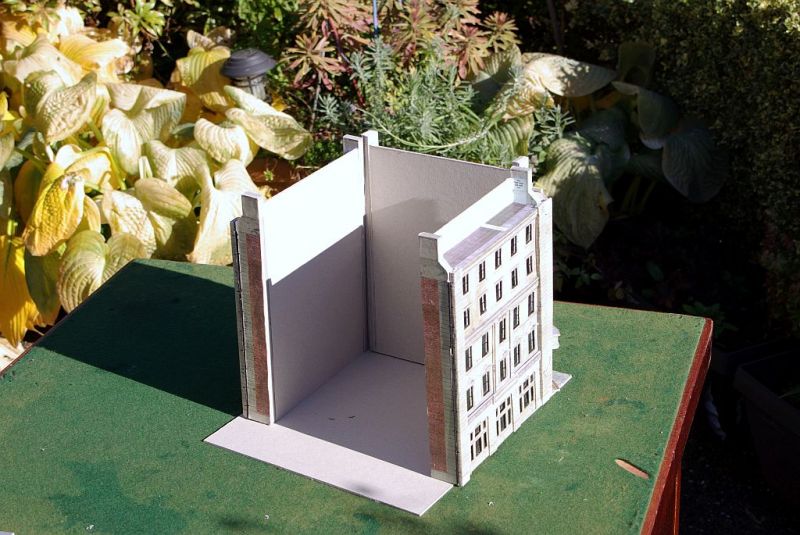
The rear view will probably be seen the most as it backs on to the main line and directly faces the entrance to the Railway Room. It will be quite challenging creating a credible industrial look that will blend with John Wiffen's sophisticated design
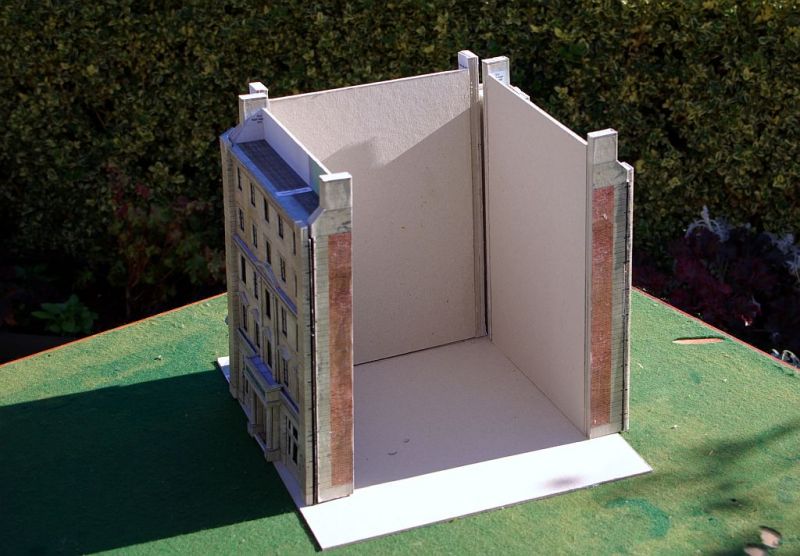
I now have the semblance of a cunning plan which I hope to be able to reveal to you over the next few weeks months. Still need to run trains and there is a Mogul about to arrive. I doubt if it will all be done before March.
Hmm February August November ……..and finally March
Doreen suggests I rename the hotel "The Four Seasons"


Posted
Full Member

Cheers Pete.
Posted

Full Member
The detail in the sunlit facades is simply superb and it matters not the time it takes, so long as the building of it, together with the result, brings pleasure. It certainly does for me :)
I'm looking forward to your cunning plan for the final side, as well as the roof. Will it include a water tank and other plant such as a lift motor room, maintenance (window cleaning) cradle, etc?
Best,
Bill
PS Four Seasons, perfect :thumbs
 Last edit: by Longchap
At 6'4'', Bill is a tall chap, then again, when horizontal he is rather long and people often used to trip over him! . . . and so a nickname was born :)
Posted

Full Member
Always try to look on the bright side of life!
Barney
Barney
Posted

Full Member
Not only is your skill at kit bashing awe inspiring but your eye for creating these scenes is uncanny. Wherever one roams on Granby, one is confronted by a scene that could almost certainly be a photograph taken at the time.
Throughout the story of Granby, there are accolades galore and every one is richly deserved. It is places like Granby that drive me on in my constantly failing efforts to create a level of realism which might bear inspection. As a reference point, one could not ask for anything more.
'Petermac
Posted

Full Member
Perfectly put, Peter, and I couldn’t agree more. I look forward to coming out of hibernation to see the finished hotel!As ever John, an extremely impressive building that will blend into the scene you're creating perfectly. Where on earth do you get your visions from !!
Not only is your skill at kit bashing awe inspiring but your eye for creating these scenes is uncanny. Wherever one roams on Granby, one is confronted by a scene that could almost certainly be a photograph taken at the time.
Throughout the story of Granby, there are accolades galore and every one is richly deserved. It is places like Granby that drive me on in my constantly failing efforts to create a level of realism which might bear inspection. As a reference point, one could not ask for anything more.
Michael
Posted
Full Member
Thank you so much for those responses…….very encouraging. I will admit its taken much longer than I intended but as I have grown older and wiser I have learned when it comes to scenery/buildings if in doubt its best not to rush!
Longchap wrote:
I'm looking forward to your cunning plan for the final side, as well as the roof. Will it include a water tank and other plant such as a lift motor room, maintenance (window cleaning) cradle, etc?
Best,
Bill
PS Four Seasons, perfect :thumbs
Thanks for the list Bill…….the roof kit includes a maintenance room…..I was in two minds whether to use it…….you have made up my mind.
I had never really thought how these ornate Victorian buildings kept the windows clean. Mind you with all the residual adhesive I have left on the model windows it may look as though they didnt bother in Granby :lol: . Did they have blocks fixed all around the roof and move the cradle from point to point?
I am trying to work out how I can install a fire escape without starting on a massive side project with plastic rod. I would hope in 1947 it might be fairly basic.
Thanks again guys
Keep Well
Posted
Full Member
Cheers Pete.
Posted
Full Member
Hi John,
I had never really thought how these ornate Victorian buildings kept the windows clean. Mind you with all the residual adhesive I have left on the model windows it may look as though they didnt bother in Granby :lol: . Did they have blocks fixed all around the roof and move the cradle from point to point?
I am trying to work out how I can install a fire escape without starting on a massive side project with plastic rod. I would hope in 1947 it might be fairly basic.
Thanks again guys
Keep Well
Most Victorian industrial buildings simply didn't bother, like all those dark satanic mills, but commercial premises, particularly customer facing areas were concerned simply had to keep the windows and external elements of the building clean, shops and hotels being perfect examples.
I've been on many commercial building's roofs in my time and even supervised witness testing for new facade maintenance equipment (I couldn't see how the system could possibly work and it didn't!) and even in Victorian days, provision was made on new builds for securing equipment, often by use of carefully located anchor points.
Pete's post below provides brilliant anecdotal evidence of what happened where anchors were not to be found and would have been commonplace before the dawn of what we know now as 'Health & Safety'.
The cradles were and still are often stored at roof level, sometimes under cover with a standpipe nearby for cleaning.
Enjoy finishing the hotel John, it provides a wonderful modelling opportunity to exercise your expertise working with these kits.
Best,
Bill
peterm wrote:
I wonder if you'll be as surprised as I was when I found out how some of those boats as they were called; worked. In my younger days as a lorry driver I worked for a short time for a scaffolding company. I was sent to an old building in St Martins Place, London with a load of weights, ropes, pullies and long stout wooden poles. It turned out that the poles went out over the edge of the facade, these 56 llb weights were tied to the inside ends of the poles and the boats were hung off of them. Not on your life would I have got in one, but the blokes that did it (cleaning probably) didn't seem to mind. Carrying that little lot up the stairs was a load of fun though…
Last edit: by Longchap
At 6'4'', Bill is a tall chap, then again, when horizontal he is rather long and people often used to trip over him! . . . and so a nickname was born :)
Posted
Full Member
A couple of questions to test your memory
Any idea of the cradle/boat dimensions?
Were the ends and sides solid or was there some form of collapsible fencing
One guy in the boat and one on the roof or?
Any other ideas will be much appreciated!
Best wishes
Posted

Full Member
This how my mother cleaned our windows.
I'm sure there is a scene from an Ealing comedy that shows one of the actresses doing just that.
Doug
'You may share the labours of the great, but you will not share the spoil…' Aesop's Fables
"Beer is proof that God loves us and wants us to be happy" - Benjamin Franklin
In the land of the slap-dash and implausible, mediocrity is king
"Beer is proof that God loves us and wants us to be happy" - Benjamin Franklin
In the land of the slap-dash and implausible, mediocrity is king
Posted
Full Member
Doug's observations are as usual well made and the logic inescapable. This is the easiest, most convenient and for most people, the most economical way to get the job done.
Sometimes however, such as hotels with customer facing areas, it is not always convenient or desirable for tradesmen or even cleaning staff to pass through occupied rooms and public spaces, so an alternative solution would need to be considered.
While suspended platforms were developed for taller buildings where ladders couldn't safely go, more so in the US to service the new skyscrapers, there are still some very scary photos on the net of chaps dangling from ropes hundreds of feet above New York sidewalks, clutching a bucket and rag with smiles on their faces!
Then, as now, domestic staff and homemakers would have cleaned windows of residential properties using bucket and water, while more appropriate systems were developed for larger and taller structures. The invention of the squeegee in the 1930s was a breakthrough, as were detergents and later on, water fed poles.
Focussing on methodology for tall mid-20th century public buildings, bosun’s chair technology would seem to be the appropriate method. It was easy to rig and use, relatively safe and of particular interest to individuals and small cleaning companies, economical!
I suspect that some of Granby's larger buildings needing regular cleaning in 1947, may have been served by some independent local contractor with a couple of men using bosun’s chair apparatus and a suitable van with ladders on the roof. Sounds like a lovely modelling cameo for an often seen, but seldom modelled activity.
Hope this helps,
Bill
Last edit: by Longchap
At 6'4'', Bill is a tall chap, then again, when horizontal he is rather long and people often used to trip over him! . . . and so a nickname was born :)
Posted

Full Member
I have just searched Google for "Cleaning windows in 1930's" and clicked on Images. Loads of ideas - including the abovementioned one of sitting "outside" with the sash windows on your lap. Useful stuff - if somewhat scary in some cases!!
Barry
Shed dweller, Softie Southerner and Meglomaniac
Posted
Full Member
Hi DougPerhaps we are forgetting that the windows would all have been sash hung, and as such there would have been no reason why the cleaners would not have been able to slide the lower and the upper sashes half down, clean the the top outside of the outer sash standing on a step ladder, and the lower half by ducking through the lower opening to sit on the sill, pulling the outer sash down on their thighs and cleaning the lower half of the outer sash.
This how my mother cleaned our windows.
I'm sure there is a scene from an Ealing comedy that shows one of the actresses doing just that.
Doug
Of course…. why didnt I think of that……and all the widowers I am using are casement

:off topic
While you are here can I pick your brain on an unrelated matter?
While researching Wrexham (Granby) I was reminded that therewas a very active leather tanning industry there.
I have another dark satanic mill from which I intend to lower something…(I havent forgotten about the stays for the other load you advised on….honest :oops::oops::oops:
Would tanned hides be bundled/baled and transported unwrapped or would they be wrapped in sackcloth?
Best wishes
Posted
Full Member
Great post Bill……thank youHi John,
Doug's observations are as usual well made and the logic inescapable. This is the easiest, most convenient and for most people, the most economical way to get the job done.
Sometimes however, such as hotels with customer facing areas, it is not always convenient or desirable for tradesmen or even cleaning staff to pass through occupied rooms and public spaces, so an alternative solution would need to be considered.
While suspended platforms were developed for taller buildings where ladders couldn't safely go, more so in the US to service the new skyscrapers, there are still some very scary photos on the net of chaps dangling from ropes hundreds of feet above New York sidewalks, clutching a bucket and rag with smiles on their faces!
Then, as now, domestic staff and homemakers would have cleaned windows of residential properties using bucket and water, while more appropriate systems were developed for larger and taller structures. The invention of the squeegee in the 1930s was a breakthrough, as were detergents and later on, water fed poles.
Focussing on methodology for tall mid-20th century public buildings, bosun’s chair technology would seem to be the appropriate method. It was easy to rig and use, relatively safe and of particular interest to individuals and small cleaning companies, economical!
I suspect that some of Granby's larger buildings needing regular cleaning in 1947, may have been served by some independent local contractor with a couple of men using bosun’s chair apparatus and a suitable van with ladders on the roof. Sounds like a lovely modelling cameo for an often seen, but seldom modelled activity.
Hope this helps,
Bill
I am moving away from window cleaning but still like the idea of some form of bosuns chair/cradle……….a heritage building like that would need inspection particularly just after the war.
I like to insert friends/family into my legends from time to time…McPeters Dairy for instance. Do you have any objection to a Modelu replica (assuming I can get one long enough) dangling from bosuns chair. Failing that I can have you supervising your staff from the pavement….standing by a an open MG TD(?) …….W.Longchap Chartered Surveyor has rather a nice ring to it.
Keep well
Posted
Full Member
Hi BarryHi John
I have just searched Google for "Cleaning windows in 1930's" and clicked on Images. Loads of ideas - including the abovementioned one of sitting "outside" with the sash windows on your lap. Useful stuff - if somewhat scary in some cases!!
Barry
Thanks for suggesting that link…….as you say lots of useful and scary ideas. It was also very helpful in that it reminded me how useful those clickable images can be. I managed to find pre war images for the AA and RAC plus a Rotary symbol which hopefully is the right period.
Thanks again
Best wishes
Posted
Full Member
I have absolutely no objection to being suspended from a rope investigating something interesting and you were spot on with my profession, which led me into a multitude of interesting adventures, even in Canada.
We are managing to stay safe and in good spirits, despite the curfew and lockdown and I cut the plywood for a second baseboard today to assemble tomorrow when my new Dewalt combi drill arrives.
Stay safe, best wishes,
Bill
At 6'4'', Bill is a tall chap, then again, when horizontal he is rather long and people often used to trip over him! . . . and so a nickname was born :)
Posted
Full Member
Thanks for the good wishes. Like the UK and France we are now under more stringent Covid restrictions. Our Province's case numbers are much lower than Central Canada but they are still pretty disturbing……..all we can do is stay within our bubble and be super careful.
Keep Safe
Posted
Full Member
[user=312]Chubber[/user] wrote:Hi DougPerhaps we are forgetting that the windows would all have been sash hung, and as such there would have been no reason why the cleaners would not have been able to slide the lower and the upper sashes half down, clean the the top outside of the outer sash standing on a step ladder, and the lower half by ducking through the lower opening to sit on the sill, pulling the outer sash down on their thighs and cleaning the lower half of the outer sash.
This how my mother cleaned our windows.
I'm sure there is a scene from an Ealing comedy that shows one of the actresses doing just that.
Doug
Of course…. why didnt I think of that……and all the widowers I am using are casement
:off topic
While you are here can I pick your brain on an unrelated matter?
While researching Wrexham (Granby) I was reminded that therewas a very active leather tanning industry there.
I have another dark satanic mill from which I intend to lower something…(I havent forgotten about the stays for the other load you advised on….honest :oops::oops::oops:
Would tanned hides be bundled/baled and transported unwrapped or would they be wrapped in sackcloth?
Best wishes
This might help.
Hides and skins - Cargo Handbook - the world's largest cargo transport guidelines website
A fount of knowledge. Just think, a relatively short time ago one would have needed to don an overcoat and take a bus ride to the nearest library to access such esoteric information!
Douglas
Doug
'You may share the labours of the great, but you will not share the spoil…' Aesop's Fables
"Beer is proof that God loves us and wants us to be happy" - Benjamin Franklin
In the land of the slap-dash and implausible, mediocrity is king
"Beer is proof that God loves us and wants us to be happy" - Benjamin Franklin
In the land of the slap-dash and implausible, mediocrity is king
Posted
Full Member
How many hand cut card and paper components do you think are needed to build three dormer windows and a plant room on this 7" x 1" space ?
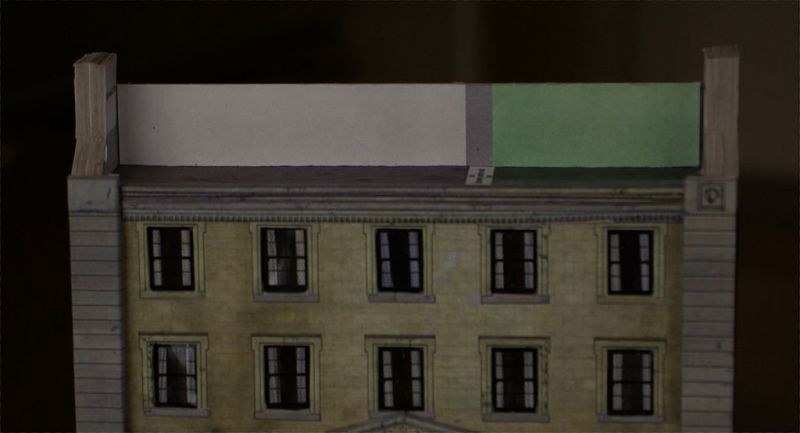
Quite a lot:
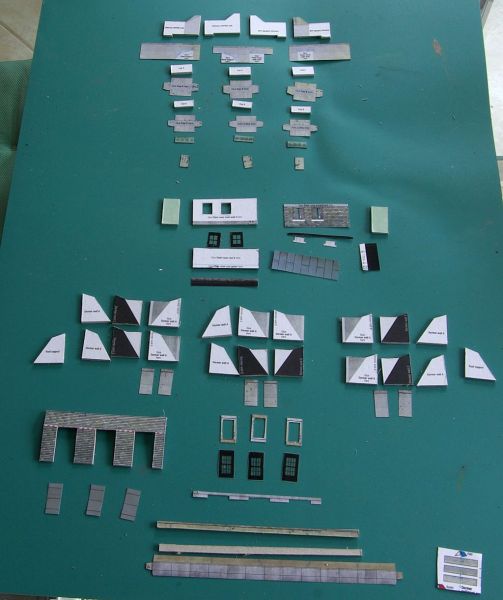
89 is the tally
I dont usually pre_cut everything like this, although its the method Scalescene suggests. I thought I would give it a try because as one gets to the end of a project the small components get scattered around several part cut sheets and its easy to miss something which later turns out to be vital!
Its actually turned out quite well. The cutting was a bit of a pain….took about three hours and I did have a slight moment of anxiety when Mrs D thought it was a good idea to open a window. However laying everything out in order makes assembly a breeze
So here is the first sub-assembly for the Chimneys
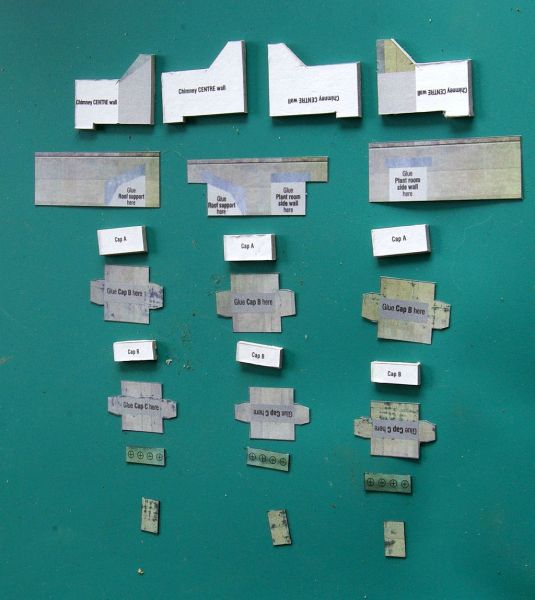
The four identical shapes at the top are cut from 2mm card. Laminated together they form the base of a third chimney. Accurately cutting small, relatively intricate shapes like this requires patience and an abundant supply of new blades. Having scored all round the shape with a new blade, apply lots of shallow cuts a line at a time. I try very hard to keep the blade at 90o for every cut
Below are printed cover layers for this chimney and the two already in place, followed by multiple chimney cap bases and covers.
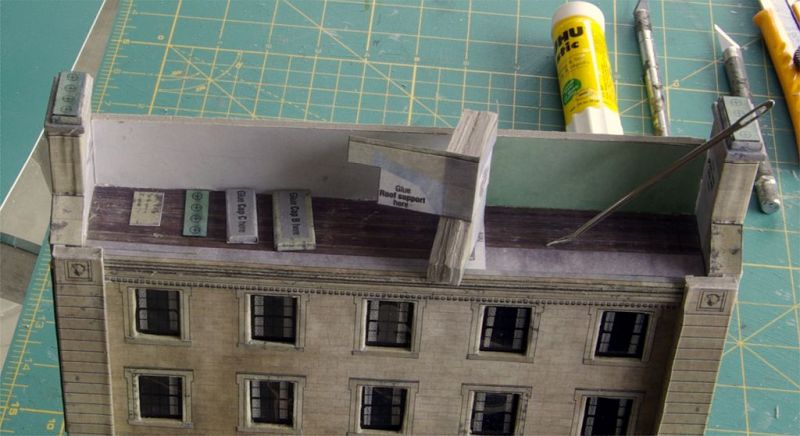
The side chimneys are now covered and capped. The centre is laminated and part wrapped. The sail-maker's needle casually leaning against the chimney? Thats the tool I used to get the crisp edge you can hopefully see o..n the centre cover layer. Chubber, mast Scalescene builder of this parish, gave me this tip:
"Before cutting out cover layers which are to be folded, prick the blue guide marks with a scalpel, flip the sheet over and with a ruler and blunt needle lightly scribe between the pricked marks". This results in a nice straight line on the correct side of the paper to achieve an accurate fold
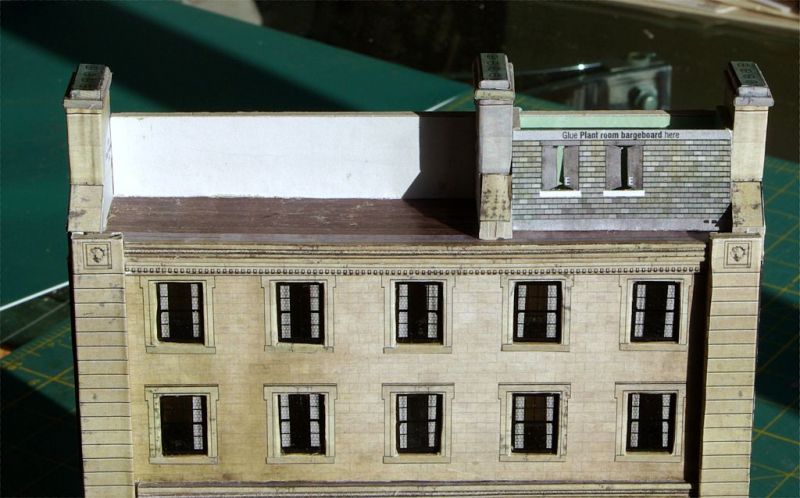
The chimney is now glued in place and we are on to the next stage with the plant room wall being test fitted.
I hope this may be of some use to aspiring Scalescene modellers…….More to come
Regards from Vancouver
1 guest and 0 members have just viewed this.