
Granby Junction 1948 N. Wales
Posted

Full Member
GWR/LMS OO Gauge DCC RR&Co
[user=2126]81C[/user] wrote:Thats very impressive Bob…….12 tankers must be approaching prototypical length?here's my milk saga when it's finished.

It must be an interesting routine attaching and detaching at the dairy…….your layout looks so spacious.
Cheers


Posted
Full Member
"Granby, a masterpiece in modelling"
That says it really, so well done John and Alan for picture of the week'
Bill
:doublethumb
Thank you for the heads up Bill. That was a very pleasant and unexpected start to a sunny Saturday morning.
Thank you for the recognition Alan, the inscription is rather flattering…….but I am not complaining!
You selected one of my favourite shots from the last batch :thumbs
Best Wishes
John
Posted
Site staff

Regards
Alan
Born beside the mighty GWR.
Alan
Born beside the mighty GWR.
Posted

Full Member
:Happy
Michael
Posted
Full Member
Thanks Michael……as I said to Bill it was a very pleasant surprise on a Saturday morning along with Bacon Butties for breakfast.! :lol:Congratulations on photo of the week John - I don't know how Alan chose from the plethora of wonderful scenes you have shared with us, but it does capture the essence of your busy timetable.
:Happy
Michael
Posted
Full Member
 While taking the photos in some sort of logical sequence, higher echelons intervened. I was requested to carry out an urgent and top priority mission……..in the garden :roll:. One has not been married for 56 years (yes …fifty six) without establishing what lifes true priorities are. By the time I returned to the train room……some hours later…….the late afternoon sun was streaming through the window, making it impossible to complete shooting the sequence until tomorrow.
So here is something a little different albeit with some connection to the Milk saga. A very simplistic and hopefully readable explanation of how these automated routines are constructed.
Granby is a DCC layout. The locos all have decoders fitted and the turnouts are all connected to DCC decoders. The track is separated into blocks. The power feed from the DCC supply is fed to each block through an occupancy detection unit connected to the DCC information net.
With my Lenz DCC throttle I can, and do, operate locos, throw turnouts and check the occupancy of blocks………but the real power of this set up is only revealed when it is hooked up to RR&Co Train Controller (TC)
Here is a screen shot of the TC main block diagram (there are separate diagrams for the storage yard and engine shed)
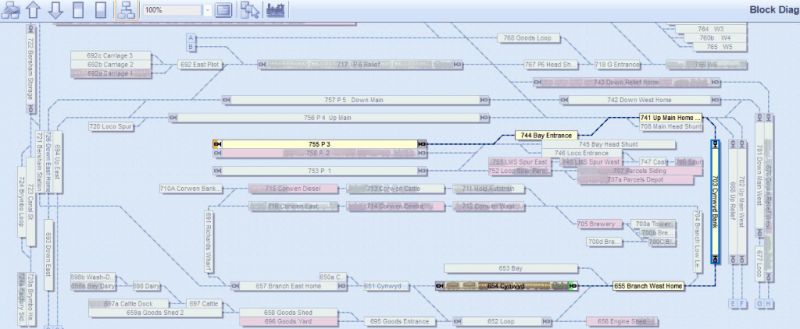
TC automatically controls the movements of a train between two or more connected blocks. This movement is called a schedule. The track connecting the blocks including any turnouts is called a route.
Once a schedule is started…..mouse click,timetable,triggered command……TC controls the train to the destination block. Reserving a designated number of blocks ahead of the train, throwing the turnouts, temporarily halting a train if the block ahead is not available.
As an example: the highlighted blocks in the diagram above is Schedule 08.50 B Set Cynwyd - Granby P3. This was the schedule that was part of the sequence that got the two full milk tankers to Granby. Here it is with the other blocks removed
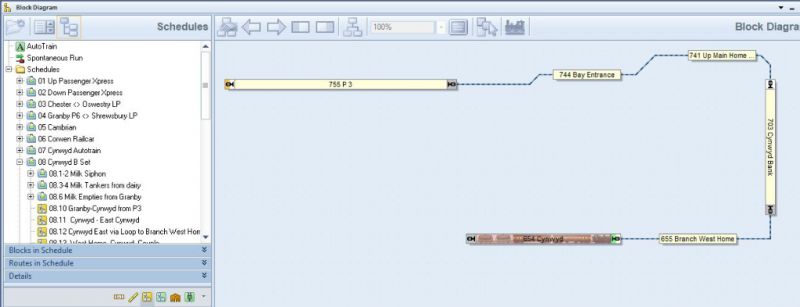
Cynwyd, the bottom block, is coloured pink to indicate that it is occupied. You may just be able to see the image within the block. It shows the separate components of the train…..Pannier 6757 / BSet / Two Tankers. As the train proceeds on its journey each block will, in turn, colour pink and display the image. When it reaches its destination at Granby, and the composition of the train changes, the displayed image within the block will reflect this.
Throughout every schedule there are opportunities to initiate other actions/commands…….signals,turnouts, block reservation and perhaps most importantly start other schedules. These opportunities arise at the start and finish of the schedule and also at the entry, exit or release of each block in the schedule. As an example, the finish operations of the Cynwyd-Granby schedule included returning some turnouts on the route to "normal" , physically shuffling the loco to uncouple and finally starting the schedule that enabled the pilot to uncouple the two tankers.
In summary, these complex routines are actually a series of individual schedules each linked to the next in what appears to be a seamless fashion. So far its taken 20 such schedules to get the tankers from the dairy to wait in Granby's head shunt for the Milk train. The entire routine from start to the finish (which I hope to write about tomorrow…..rain is forecast) was started by one mouse click (or timetable entry) ……the reverse of the schedule shown above ……Schedule 08.10 Granby - Cynwyd B Set.
For those who waded through all that….. here are a few leftovers from last weeks post……experiments with an Iphone

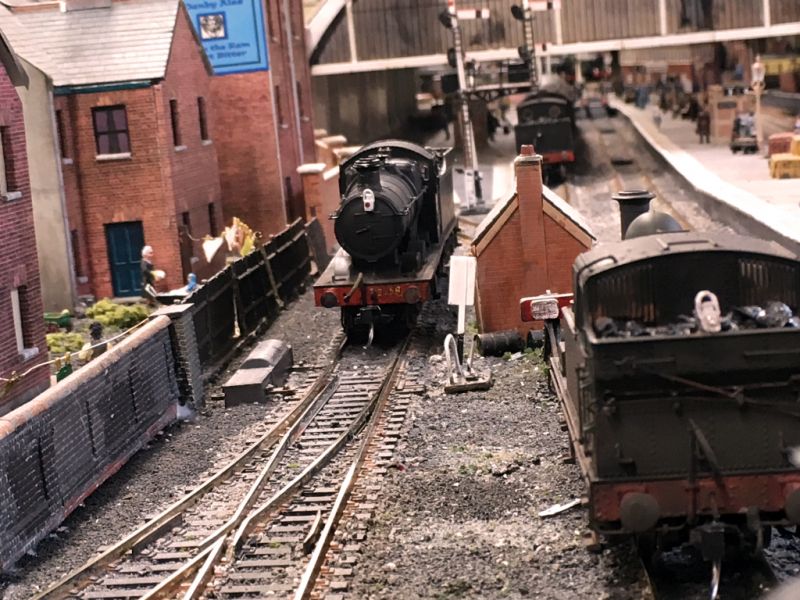

Northern grit…….despite everything the washing is still hung out to dry….probably accompanied by a few choice words from Bronwen to Gareth Williams the fireman on 2259.
 Last edit: by John Dew
Posted

Full Member
And the dilemma of hanging the washing out when living by the tracks is an amusing touch.
Posted

Full Member
Posted

Full Member
You have a fine gift for making RR&Co sound remarkably simple. I know that's aided by the system being based on logic, as computer processing, by essence, is and that logic by its very nature is straightforward. However, I also know that compiling these schedules will be taxing, but treated as a puzzle, should certainly be fun.
I'm getting to see that computer control can keep one's grey matter engaged for hours and also be useful in maintaining mental agility.
I now see the merit in wiring a layout for occupancy detection at the outset, even though one may not be certain of embracing computer control to the full.
You know, it’s probable only a matter of time now until Peter starts asking you how to wire for occupancy detection!
Thank you for the continued entertainment.
Best,
Bill
Last edit: by Longchap
At 6'4'', Bill is a tall chap, then again, when horizontal he is rather long and people often used to trip over him! . . . and so a nickname was born :)
Posted
Full Member
Interesting to hear more about how the control system operates, and those are some very nice photos!
And the dilemma of hanging the washing out when living by the tracks is an amusing touch.
Thanks Brendan……..the iphone experiment was interesting for a number of reasons. The main reason was to try and gtake shots from new and different angles…….I have built up to the edge of the baseboard so much that there are very few avenues available for normal eye level shots……Granby appears to be perpetually under surveillance from a drone….and I felt my shots were becoming repetitive.
The surprising thing was the overall quality…..I usually run all my shots through the affinity suite before re sizing but a couple of those shots were straight from the phone!
Posted
Full Member
DaveH_Murcia wrote:
As usual John, a very readable explanation of how RR&Co software and DCC achieve some great things. We all know it could be done manually using DC with isolated sections etc but that would be all you could be concentrating on. For me, once you have a schedule (or schedules) running there is always the opportunity for a bit of shunting or even manually running a train through computer controlled territory - the best of both worlds. Put a camera on the front and with automated signalling it could get very interesting - now where was that master stop button.
Thanks Dave…….I am glad you liked it……..it was difficult to know how to pitch it but I thought it might be useful for non users to help follow some of my more tortuous routines :roll:
I agree about combining auto running with manual shunting its something I want to do more of in the future.
In case you are not aware there is a new update version 9.0 A5………I havent downloaded it yet but looking at RR&Co forum it doesnt seem to have sparked too much trauma so I will download in the next few days
Cheers
Posted
Full Member
Longchap wrote:
Hi John,
You have a fine gift for making RR&Co sound remarkably simple. I know that's aided by the system being based on logic, as computer processing, by essence, is and that logic by its very nature is straightforward. However, I also know that compiling these schedules will be taxing, but treated as a puzzle, should certainly be fun.
I'm getting to see that computer control can keep one's grey matter engaged for hours and also be useful in maintaining mental agility.
I now see the merit in wiring a layout for occupancy detection at the outset, even though one may not be certain of embracing computer control to the full.
You know, it’s probable only a matter of time now until Peter starts asking you how to wire for occupancy detection!
Thank you for the continued entertainment.
Best,
Bill
Thanks Bill…….glad you liked it. You are right it does keep the brain active. It can on occasion be quite frustrating but it is extremely satisfying when you arrive at a working solution. The fact the schedules are like building blocks means that nothing becomes too overwhelming.
I now see the merit in wiring a layout for occupancy detection at the outset, even though one may not be certain of embracing computer control to the full.
It makes a lot of sense, is very easy to do and as a side benefit will make fault finding when running conventionally much easier. In essence all you have to do is run the feed (not the common) for each block to a labelled choc bloc and then connect to the DCC bus. Any later conversion is a breeze
I believe (hope :lol:) Peter is following this approach with both Maxmill minor and major!
Cheers
Dividing the layout into blocks
Posted

Full Member
I too have suffered from a long list of "gardening chores" this spring so progress has been mental rather than physical.
Once Liz has everything to her liking - both inside and out - I may be allowed to spend some time on a new home for Maxmill. I think perhaps an hour just before dawn might be possible …………………………….. You, and many others, will be aware of how retirement works …………… :roll: :roll: :roll:
Whilst you do make RR&Co sound quite simple I can already sense the fire kindling in my grey matter at the thought of trying to meld all that "simple" logic into an operating sequence. Walking is basically simple but I shudder to think how many individual "moves" our brains must go through to achieve each step. I wonder, do you work it all out on paper first ?
I'm also amazed by the quality of your phone camera shots - they really are very good.
'Petermac
Posted

Legacy Member
Once you have grasped the basics you open up an entire new area of the hobby which can be entirely engrossing and satisfying.
Brian
Last edit: by Briperran
OO gauge DCC ECOS Itrain 4 computer control system
Posted
Full Member
Whilst you do make RR&Co sound quite simple I can already sense the fire kindling in my grey matter at the thought of trying to meld all that "simple" logic into an operating sequence. Walking is basically simple but I shudder to think how many individual "moves" our brains must go through to achieve each step. I wonder, do you work it all out on paper first ?
Hi Peter
Thanks for the kind remarks :thumbs
Its a bit like cooking in a way…..just as one has a pantry so I have a library of schedules many of which are tried and tested over the years. The Cynwyd-Granby B Set Schedule is a stock item I have been running it for 8 years……to add the tail traffic just needed creating a couple of new dedicated short schedules to and from the Bay. I just do a schedule at a time running it manually and then automatically on its own until I am satisfied. Then on to the next schedule, testing it and then finally linking the two together and then on to the third and so on.
Some are very quick ….a two block dog leg only takes 30 minutes…….the complicated ones coupling and uncoupling can take half a day to get right.
The TC files are on a flash drive so I move them between the railway room and a laptop upstairs……a lot of the repetitive keyboard work can be done there with a glass of wine while half watching TV . TC has a simulator so you can use that to test stuff but I rarely do that now……I find this brick by brick (oh dear I am mixing metaphors) seems to work best for me.
Cheers
John
Posted
Full Member
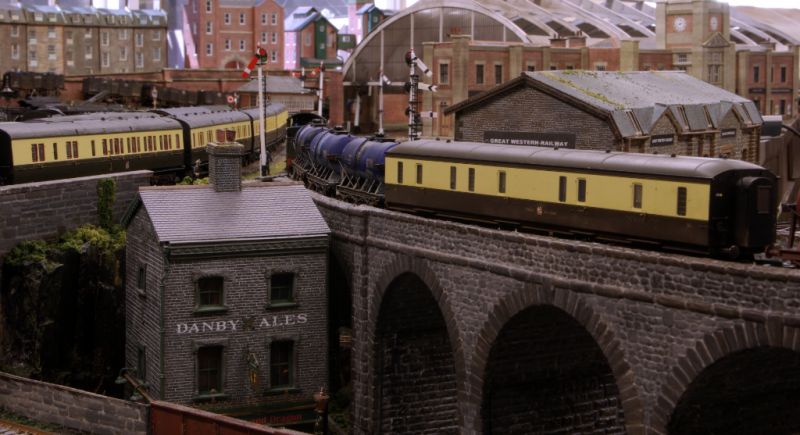
The Down Milk Train from Shrewsbury headed by 6832 Brockton Grange approaches Granby Viaduct

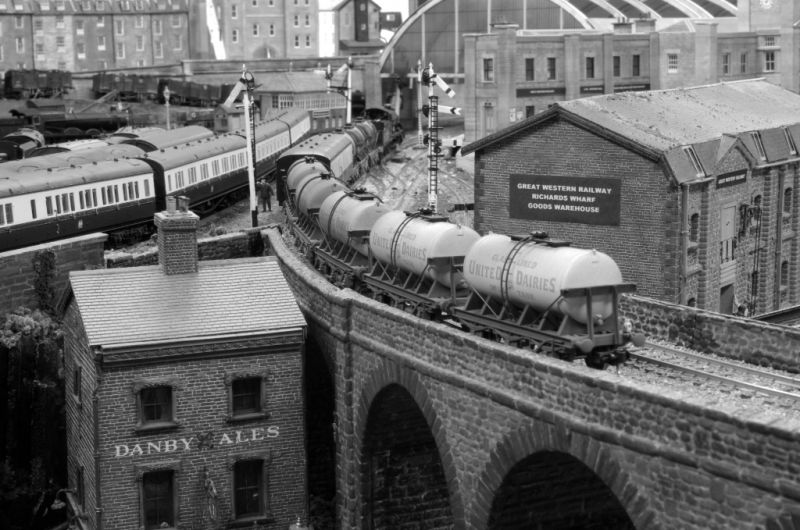
Note the tail lamp……a stopped clock is right twice a day…….bit like that with my lamps
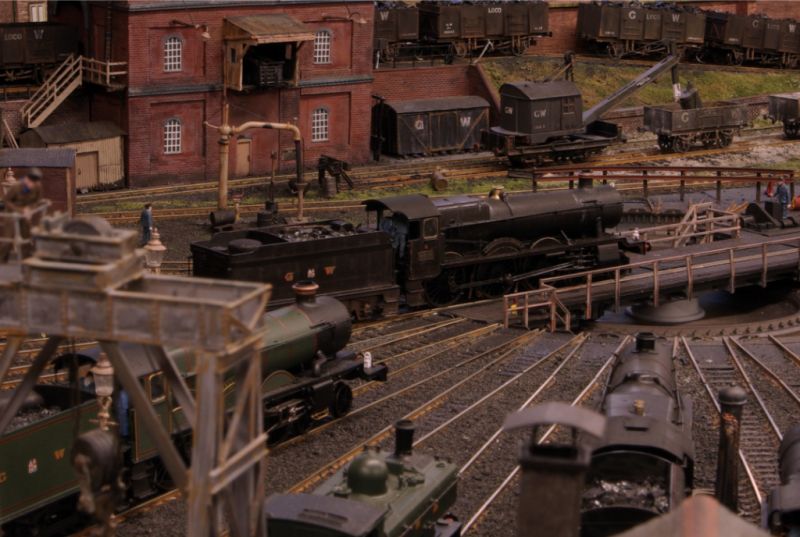
No I havent got the photos mixed…..this is 4918 Dartington Hall in GWR Wartime livery preparing to leave Granby Shed to relieve Brockton Grange.
The sequence of schedules to get 4918 on to the exit road via the turntable is triggered at the same time as the Milk Train leaves the storage yard
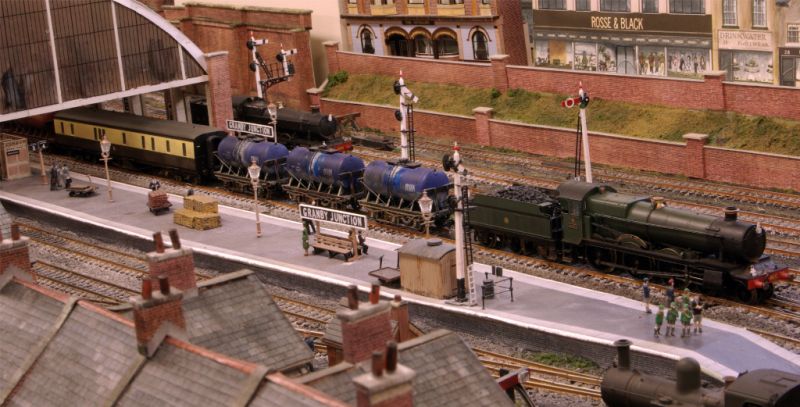
The Grange crawls to a halt, just over the magnet, on Platform 5 . In the background on Platform 6 you can see the relief Hall in readiness

The Grange uncouples, moves forward to clear the xover points and then reverses back on a schedule that will take her direct to the Shed reception. Once there, the suite of schedules, seen on the video, will take her through the ash pit, coaling stage, turntable and finally to her home on Shed #4.

I must confess that the shot above was staged so I that could show both locos. In reality the relief loco stops out of sight behind the station roof thus allowing adequate clearance for the relieved loco…..
.guess how I worked that out :oops:
When the Grange exits the Down Main block in front of the xover, the schedule to bring the Pilot and tankers from the Up Siding is started
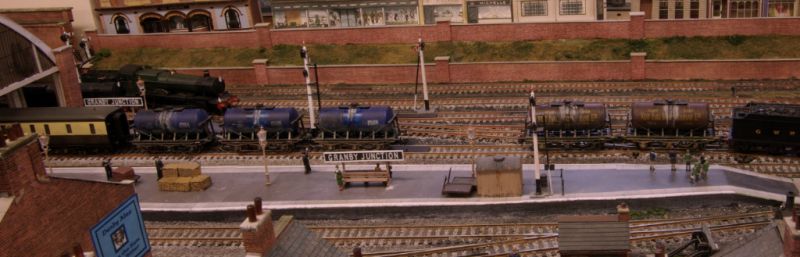


This was one of the more difficult schedules to accomplish both physically and getting TC to recognise what was happening.
The pilot has to push the two tankers into contact and then continue pushing…but now its the entire train. It then has to stop so the loco tender coupling is just short of the magnet. A short distance move back and forward couples the new tankers with the train and at the same time open the pilots tender coupling
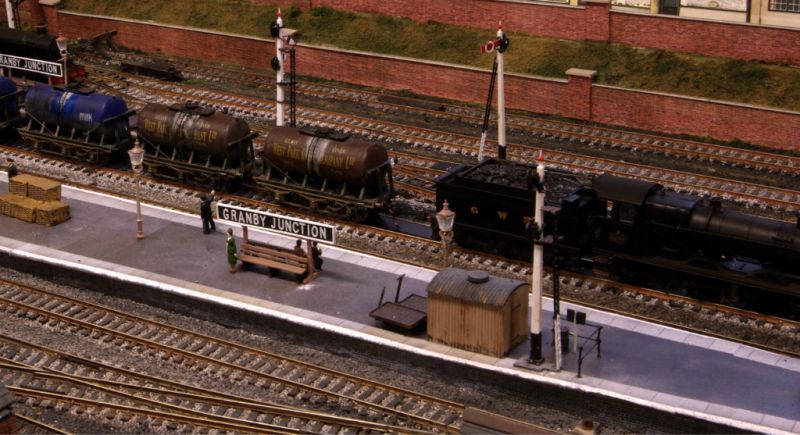
The pilot moves forward leaving the train in Platform 5
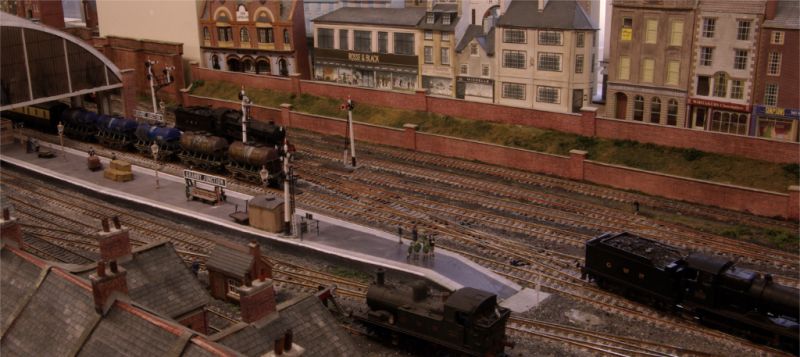
The pilot moves over the xover and on to the Up line before reversing into Bay Platform 1 and its stabling point near Bronwen's washing…..she will be thrilled
As the pilot enters the Up Main block this action starts the schedule that will bring Dartington Hall from Platform 6
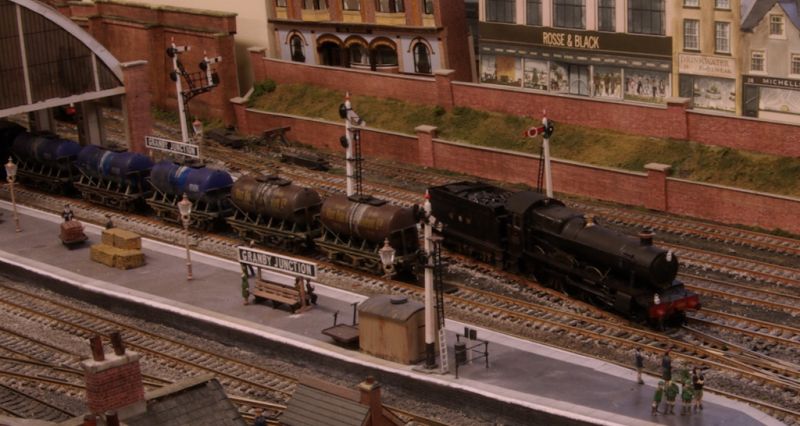
Over the Xover to the Down Main
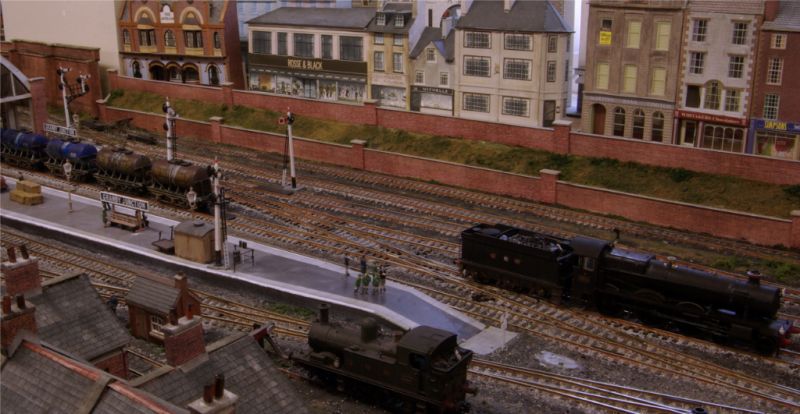
Where it reverses to couple with the milk train in Platform 5 ready to depart for Hooton
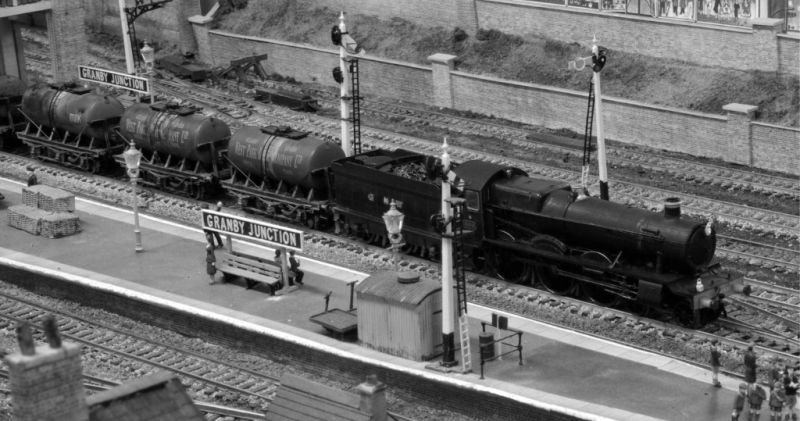
Thats 36 schedules from when the tankers were picked up from the dairy… some weeks ago :roll:
Two more and we are done!
Edited 5/4 corrected some platform #s which must have been confusing….my apologies
Last edit: by John Dew
Posted
Full Member
And yes, I think I can guess how you worked out that spacing arrangement. Hopefully the locos didn't need too much mending time after
Posted

Full Member
I'm discovering that part of the dark art of scheduling is to return a loco ( or another loco) to the starting position of a schedule. Is there a secret to this or just a lot of well planned and timed scheduling?
Posted
Full Member
Excellent photos, John!
And yes, I think I can guess how you worked out that spacing arrangement. Hopefully the locos didn't need too much mending time after
Thanks Brendan…….it was just a glancing blow…..more embarrassing than anything else!
Cheers
John
Posted
Full Member
Hope you still have plenty of 127 film in that Brownie of yours, as I never tire in seeing Granby and its environs.
Best,
Bill
(relaxing after a wonderful meal at our local village restaurant)
At 6'4'', Bill is a tall chap, then again, when horizontal he is rather long and people often used to trip over him! . . . and so a nickname was born :)
1 guest and 0 members have just viewed this.