
Granby Junction 1948 N. Wales
Posted
Full Member
GWR/LMS OO Gauge DCC RR&Co
[user=434]John Dew[/user] wrote:Its one out of four of the latest Hornby offerings I purchased last year and it runs fine there is slight noise from the worm drive on all of them it might go as none of them have been run in, I replace the 30 y.o.old Airfix loco's as they had really come to the end of their useful life gears worn, wheels wobbling and other maladies the wheels were a magnet for dirty once the chrome had worn off they spent more time in bits than working, with Hornby loco's they run nicely I can't believe people had slated them so much in the past they will do untill the new new models come along if they are so much better in the mean time they will have a bit of detailing done to them.The GWR would use any coach to make up a train so it prototypically correct if you had the pleasure of being in the yard at Old Oak Common the rows of coaches stored there were a right old mix.Very nice Bob! The missing brake van is now on its way and I have almost finished painting the rooves of the other three……meantime I will tag on a Bow end corridor to temporarily make up the 4 car set, while I continue to perfect (??) the schedules using a 56xx and the two Ivatt 2-6-2s
How does the your large prairie run ? I tried a couple some years ago but they were very poor…….I am hoping that Hornby's new offering arrive on time be a big improvement…..
Cheers
:)


Posted

Full Member
You must have very delicate hands - Fairy Liquid ? ……………… :lol: :lol:
'Petermac
Posted
Full Member
 Last edit: by 81C
Posted

Full Member
Hi Ken[user=1916]ZeldaTheSwordsman[/user] wrote:Headmaster, I believe it was indeed fairly common for first trains of the day to have a milk van or tanker (possibly more than one, depending) attached, but my knowledge is second- and thirdhand.
John, I would presume that on a suburban commuter train the destination boards would be used to show the train's terminus and possibly a route or other indicating number.Reading this I thought you might be interested in this "N" gauge loco of mine which I bought on Ebay some years ago. It's had various improvements e.g., the moulded hand rails have been removed and replaced with brass wire ones complete with hand rail knobs, the milk tanker has been fitted with pickups and hard wired to the loco pick-ups to ensure really smooth running plus real coal added to the bunker etc., etc.Ken
Thats a super job you have done with both loco and tanker. The hard wire connection looks very neat. I will bet the additional pick ups make a world of difference to performance. Fortunately Bachmanns 00 gauge panniers are very reliable performers but I do have to struggle with some 0-6-0s to get them working properly.
Best Wishes
John
Posted
Full Member
I may have missed out then. I was so disappointed with my original Hornby Prairie that when they re -released them a few years ago I just didnt bother. Hopefully I will not be disappointed with the new ones. I see Dapol's Mogul has now slipped again to Spring(?) 2020…..I would guess their Prairie is firmly on the back burner.I can't believe people had slated them so much in the past they will do untill the new new models come along if they are so much better in the mean time they will have a bit of detailing done to them.The GWR would use any coach to make up a train so it prototypically correct if you had the pleasure of being in the yard at Old Oak Common the rows of coaches stored there were a right old mix.
:)
Best wishes
Posted
Full Member
You may recall that the first stage consisted of transporting two full tankers, as tail traffic, on the regular passenger service from Cynwyd to Granby.
Stage 2 involves detaching the tankers from the train and moving them to a siding to await the arrival of the Milk train from Shrewsbury. In addition the normal loco exchange still has to take place so the passenger train is ready for its return journey.
Two pannier tanks are allocated to the passenger service. Here we see both of them

6757 approaches Granby hauling the train plus tankers. The relief loco, 5773, awaits its turn in the loco siding.
The station pilot, Collet Goods 2259 will be detaching the tankers
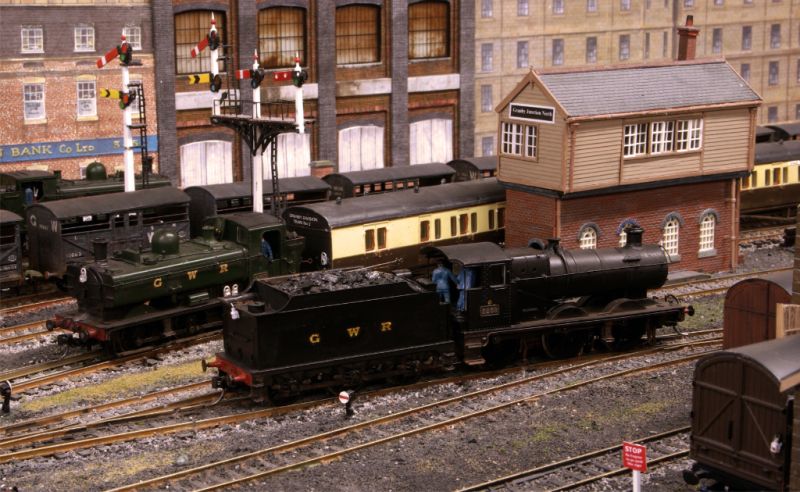
Once the passengers have left, the incoming loco 6757 uncouples and moves clear of the train
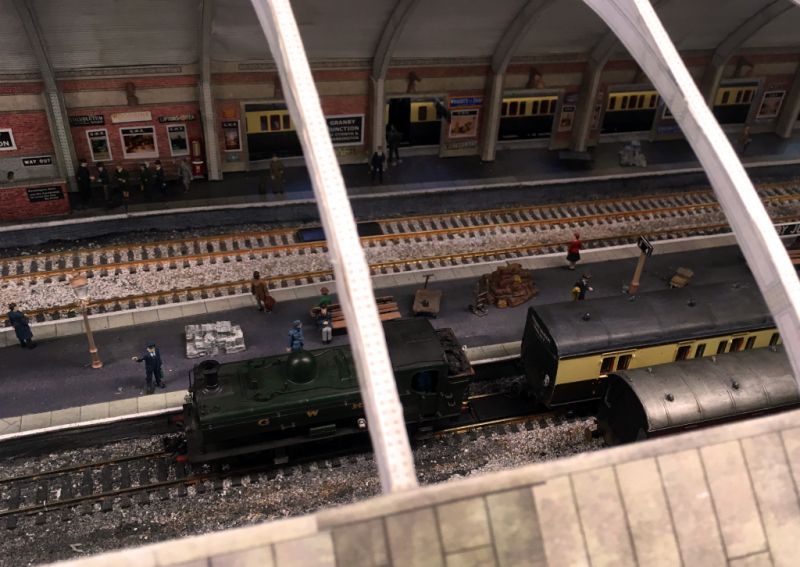
At the other end 2259 backs on to the train
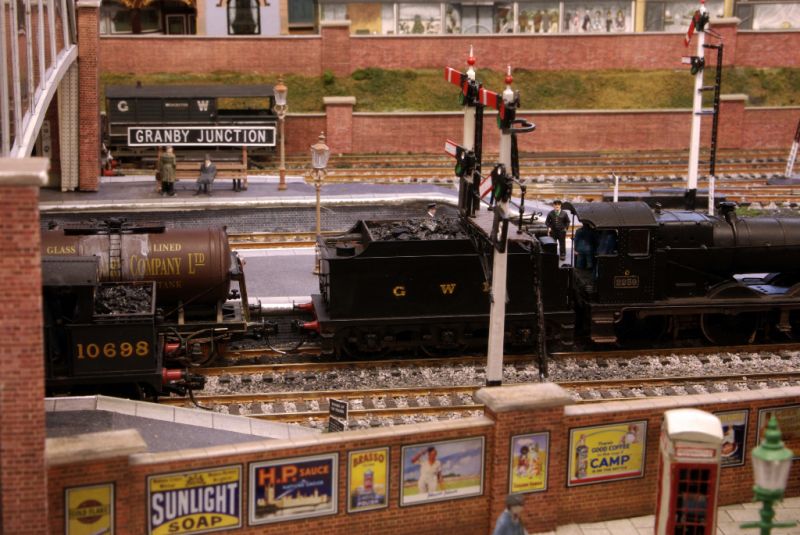
The loco pushes the carriages and tankers back about 5" so the coupling between the coach and tanker stops over a second magnet. Having been pushed back this coupling will remain open while over the magnet.
When 2259 initially makes contact with the tankers the loco generally pushes the train back on the open horns of the couplers.Completing the coupling is now much easier since RR&Co introduced a nifty feature called "Limited Distance Move". In the commands at the finish of this schedule the loco moves backwards at the slowest possible speed (Decoder step 1: 2 mph) for 0.25 " and then forwards at the same speed for 0.5"…….job done! An elegant and effective Kadee shuffle.
2259 and the tankers move off, leaving the coaches in the bay
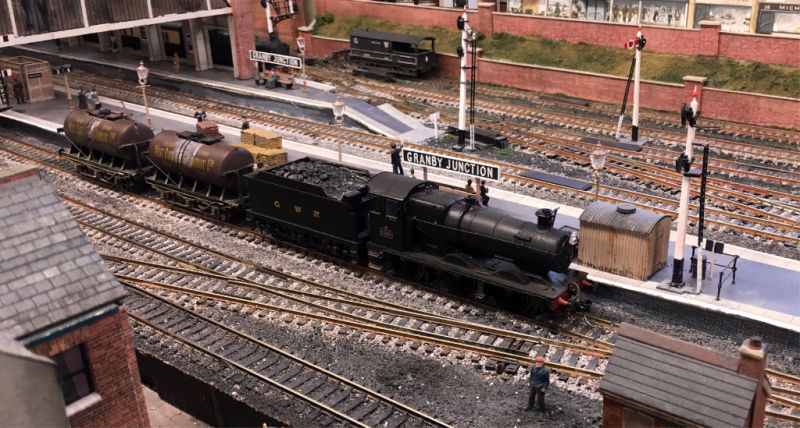
2259 moves out briefly on to the main line before entering the Up Head Shunt.
Simultaneously the relief loco ,5773, leaves the coal stage and now waits for the entry to P3 to be released
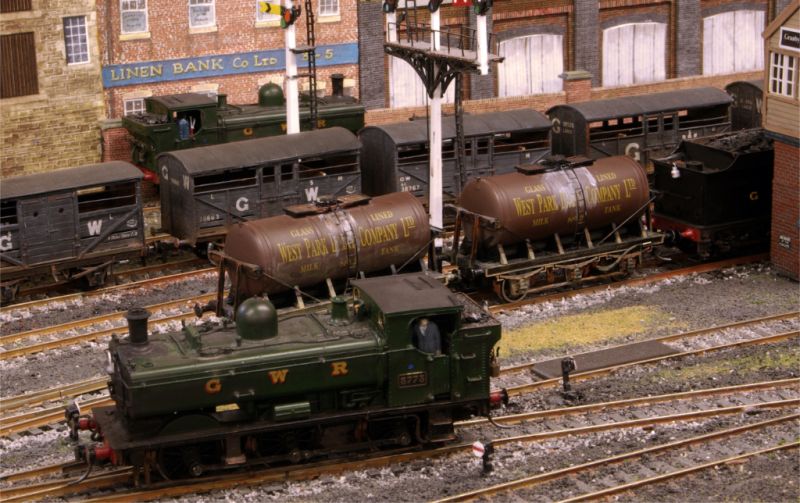
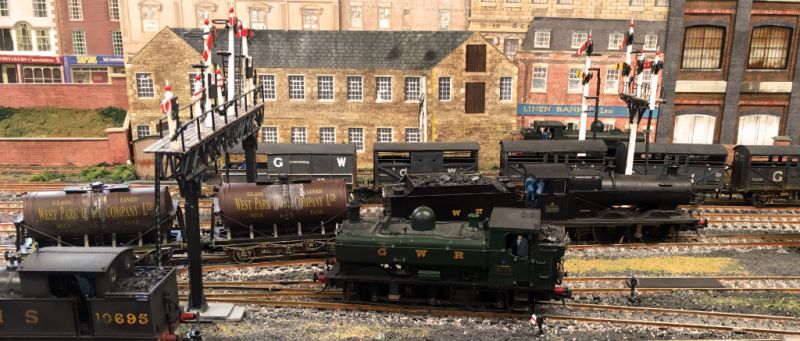
2259 and the tankers will now wait in the Head Shunt for the Down Milk Train to arrive

And 5773 can move into Platform 3 to couple with the carriages
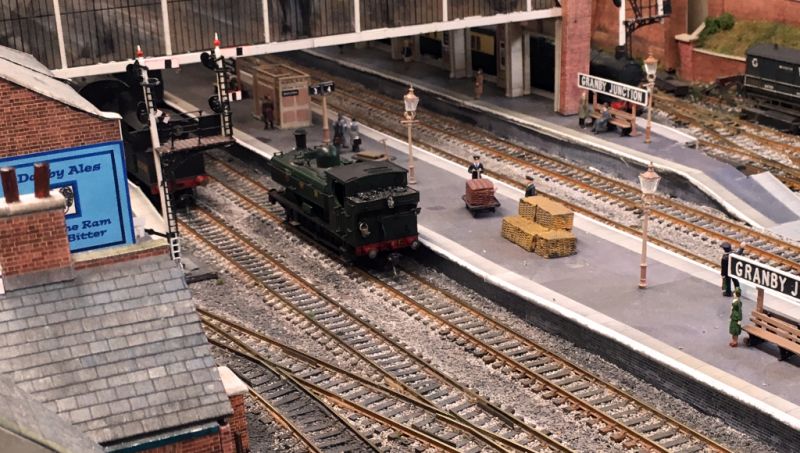
Once coupled it pulls them back into the Bay carriage siding

Releasing 6757 to the loco siding

All the participants in view in this shot
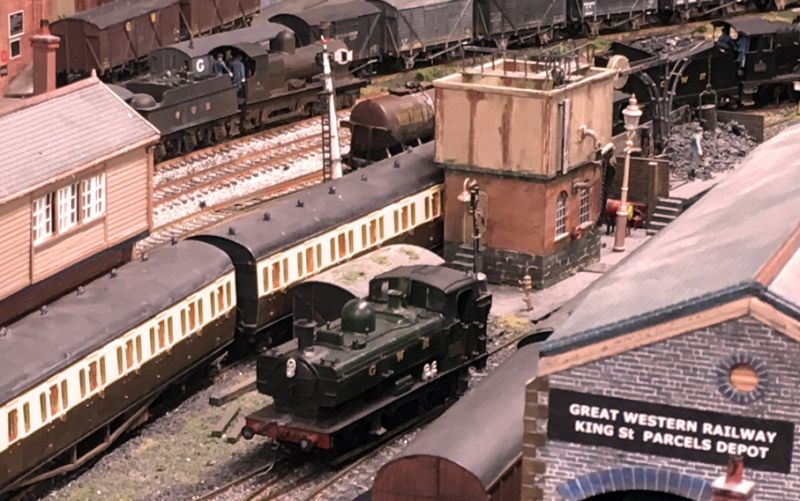
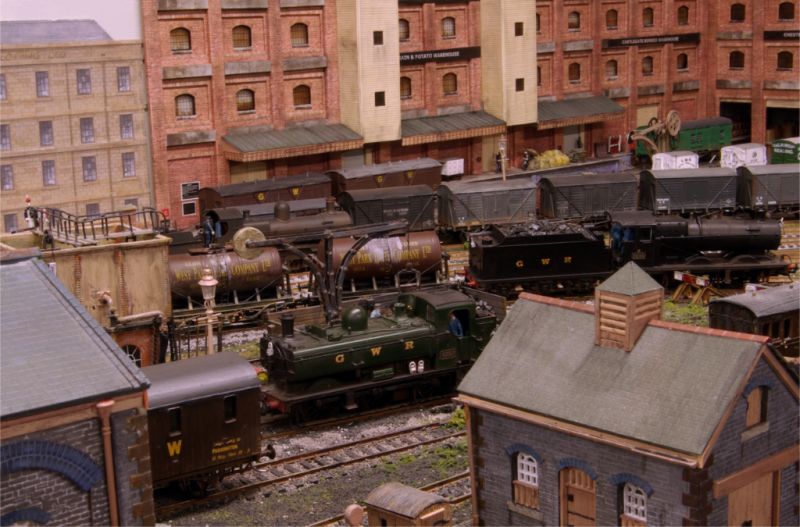
5773 can now return to P3, with the coaches, ready for the return trip.
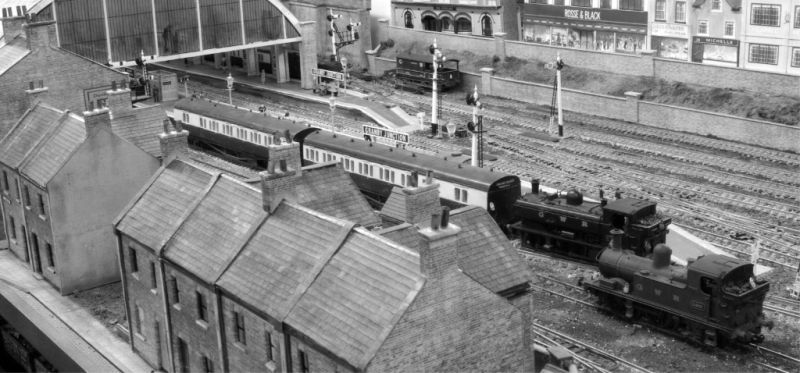
For those interested we are now at 20 schedules for this routine with more to come.
Regards from Vancouver where Spring is now with us.
Posted

Full Member
Regards
Michael
Posted
Full Member
I always worry that these sagas that I find so compelling will be boring to others.
I am delighted you found it interesting
Cheers
Posted
Site staff

So, how long do the tankers have to wait in the head shunt for the down milk train.
Ed
Posted
Full Member
Bob
Posted
Full Member
I appreciate the Collets with their dirtied grey roofs, as pristine white immeadiately degenerated on leaving the carriage works, never to be washed in service, unlike the sides. I'm also expecting my other Collet brake any day soon now, as Hattons posted it before the weekend.
Best,
Bill
At 6'4'', Bill is a tall chap, then again, when horizontal he is rather long and people often used to trip over him! . . . and so a nickname was born :)
Posted

Full Member
Posted
Full Member
Ed wrote:
Not boring at all John, quite fascinating.
So, how long do the tankers have to wait in the head shunt for the down milk train.
Ed
Hi Ed
These are the provisional timings I am working on
9 am Churns collected by branch train (off scene most milk arrives at dairy by road) *
1.05 Branch train collects 2 full tankers
1.50 Tankers arrive at Granby
2.10 pm Down Milk Train arrives from Shrewsbury…. Tankers are attached…..departs for Birkenhead
6.30 pm Train returns to Shrewsbury with Empties drops 2 at Granby
8 pm Branch returns Empties to Wash Bay in Dairy and moves second clean set to Dairy loading bay ready for next days sequence
So I have allowed 20 minutes between the arrival of the passenger train and the milk train.
Its mostly guesswork but I asked Petermac, who knows about these things……after all his family own the dairy….MacPeters! He said the timings look about right. Time was of the essence……the tankers were not refridgerated just glass lined
81C wrote:
My ex SiL had a BR modern image layout you hit the the start button and off it all went it certainly didn't do it for me but your system John has aroused interest, can you run other trains while the automation is in motion? or does it require a separate track or curcuit to do that.
Bob
Hi Bob
You can run as many additional trains/locos as your computors processing speed and memory can support. Thats probably an oversimplification but is broadly correct. They can be either other separate automated routines or individual trains controlled by the RR&Co or DCC throttles. There are obvious limitations….. you cant manually drive a loco that is part of an active automated routine nor drive a different loco over routes that are being used in that routine.
As an example you can run expresses or long goods trains etc automatically round the main line and at the same time manually shunt the goods yard.
I will try and write a better explanation later……I have been longing for an excuse to do so……thank you for the excuse
Cheers
Last edit: by John Dew
Posted
Full Member
I am always amazed by how smoothly you manage all the complicated routines - or at least you "appear" to manage…………………I'm sure there are an awful lot of "moments" in the planning and fine tuning before you "go public".
Please, don't ever think your posts are boring …………………….. :It's a no no
'Petermac
Posted
Full Member
Michael
Posted

Full Member
Posted
Full Member
Thanks DaveGood to see the Panniers in action !
If in doubt ……..use a pannier :thumbs
You may have seen a 14xx banished to a siding………its a lovely loco and an ok runner but when it came to all that shunting I brought on all my proven favourites……two panniers and the collett (I added tender pick ups and some weight)
Cheers
Posted
Full Member

Posted
Full Member
That says it really, so well done John and Alan for picture of the week'
Bill
At 6'4'', Bill is a tall chap, then again, when horizontal he is rather long and people often used to trip over him! . . . and so a nickname was born :)
Posted
Full Member
Hi PeterNot only is Granby an inspiring layout John but you make RR&Co seem so appealing …………………………. :hmm
I am always amazed by how smoothly you manage all the complicated routines - or at least you "appear" to manage…………………I'm sure there are an awful lot of "moments" in the planning and fine tuning before you "go public".
Please, don't ever think your posts are boring …………………….. :It's a no no
My apologies for not acknowledging earlier yet another charming post from you.
I had hoped to write a very brief description of how these routines are built up from (in some cases) a myriad of individual schedules …….but its stuck in the pending tray. :oops:
RR&Co reminds me of learning to ski…….very daunting to start……..steep learning curve…..almost step like…huge sense of achievement when you attain each slightly higher plateau.
You are correct a great deal of testing is required along with a certain amount of mental agility in deviating from Herr Freiwalds intricate protocols without his software noticing! :shock:. Sure beats Sudoko for keeping an OAP mentally alert.
Nowadays the "moments" you refer to usually result from either operator error or an unreliable loco and of course my patches of dodgy trackwork.
At the end of the day though …lots of fun
Cheers
1 guest and 0 members have just viewed this.