
Granby Junction 1948 N. Wales
Posted

Full Member
GWR/LMS OO Gauge DCC RR&Co
81C wrote:Hi John the 4th non corridor carriage R4877 is being advertised on the Hornby website it should be in he stores by next week.
Enjoy Bob
Thanks for the heads up Bob………I am still waiting for the first three…..hopefully they are in Canada but not this part. The mail seems to be taking longer…..I got two decoders yesterday that were sent from Sheffield on Feb 5 :roll:
Patience is a virtue I am told
Cheers


Posted
Full Member
Absolutely fabulous photos John - as ever !!
I wonder if you'd ever thought of putting a pipeline in from the cattle dock to my namesake's dairy ? The cows in there look just about ready for milking ………………………….or are they steers ( :???:) ?
Also, I'm delighted to see a couple of LNER box trailers in the last photo - are you leaning towards "the other side" or are they intruders……..?
Every photo is bursting with detail - a joy to study at length. I'm aslo with Zelda in that I can't wait to see the Dew Studios production of it all in motion.
Nearly forgot to ask - are the signals working or posed ?
Thanks Peter …..I am glad you liked the photos…..including the two behind the Tv!
Dont know about milking the cattle…..they definitely need dusting…….the routine to get them to and from Corwen Market is halfway down the "should do " list :oops:
The LNER (ex GCR) actually ran through Wrexham and then up the Wirral. In fact the line was still operating when we emigrated in 1981. There is a small presence on Granby….you may recall I had a V2 and still have a J36 (?) 0-6-0 on a goods run …….I also have a teak passengerbrake van which I couldnt resist…although it doesnt like some of my curves!
The signals I am afraid are all cosmetic….. To do the entire layout would be unrealistic now but I keep thinking about the branch….its very tempting
A question for you if I may.
This whole milk/parcels sequence is going to be one of the foundations for my timetable……….does this sound about right to you from a farming perspective?
9 am Churns collected by branch train (off scene most milk arrives at dairy by road) *
1.05 Branch train collects 2 full tankers
1.50 Tankers arrive at Granby
2.10 pm Down Milk Train arrives from Shrewsbury…. Tankers are attached…..departs for Birkenhead
6.30 pm Train returns to Shrewsbury with Empties drops 2 at Granby
8 pm Branch returns Empties to Wash Bay in Dairy and moves second clean set to Dairy loading bay ready for next days sequence
* I assume I have to do an afternoon/evening collection but I think there would only be one daily shipment to the main line
Any advice would be much appreciated. My agricultural knowledge is very limited!
Cheers
Posted

Full Member
Thanks for showing how you run the TT in conjunction with TC - elegant piece of bodging !
Posted

Full Member
Will the whole timetable be run by RR&Co or will you be able to run trains manually at the same time? Will it all be set up so that you can sit back and watch your model world come to life? I imagine that is incredibly satisfying!!
Regards
Michael
Posted
Full Member
No problem Dave………its not entirely original (and hardly elegant :lol:). Its my interpretation of one of Herr Freiwald's more enigmatic sections in the manual :roll:Hi John,
Thanks for showing how you run the TT in conjunction with TC - elegant piece of bodging !
Cheers
Posted
Full Member
Once again John, lovely photos of beautiful modelling - all very evocative of a real place and time with so many things which catch the eye.
Will the whole timetable be run by RR&Co or will you be able to run trains manually at the same time? Will it all be set up so that you can sit back and watch your model world come to life? I imagine that is incredibly satisfying!!
Regards
Michael
Thank you Michael :thumbs
Yes its the RR&Co timetable combined with the systems fast clock. You can always run trains manually while others are under the control of schedules/timetable and Train Controller will track them…….but its tricky if you change the composition of a train in manual mode
You can sit back with some roundy roundy routines but if a routine involves coupling and uncoupling I tend to hover over the critical moments………the loco of the Cambrian Express surging out of the storage yard……..leaving its coaches in the yard…….is both embarrassing and potentially messy. It doesnt happen too often….but once is enough……so no sitting back……..but you are correct, when a long complex sequence all runs seamlessly it is indeed very satisfying.
Cheers
Posted
Full Member
Regards
Michael
Posted

Full Member
Hi John…………………………………………………..
A question for you if I may.
This whole milk/parcels sequence is going to be one of the foundations for my timetable……….does this sound about right to you from a farming perspective?
9 am Churns collected by branch train (off scene most milk arrives at dairy by road) *
1.05 Branch train collects 2 full tankers
1.50 Tankers arrive at Granby
2.10 pm Down Milk Train arrives from Shrewsbury…. Tankers are attached…..departs for Birkenhead
6.30 pm Train returns to Shrewsbury with Empties drops 2 at Granby
8 pm Branch returns Empties to Wash Bay in Dairy and moves second clean set to Dairy loading bay ready for next days sequence
* I assume I have to do an afternoon/evening collection but I think there would only be one daily shipment to the main line
Any advice would be much appreciated. My agricultural knowledge is very limited!
Cheers
You are correct in that churns would be collected from the farm, by lorry, once daily. Depending on the route, it might be early in the morning, in which case it would comprise the whole of the previous day's milking or, if closer to mid-day, it would be the previous evening plus current morning's milkings. To my knowledge, churns were seldom collected ex-farm after mid-day. I suppose pre-war, farmers must have delivered their churns to the local station although that's well before my farming days …………….
Bear in mind that railway milk tankers would be "thermos type" insulated rather than refrigerated so time was of the essence. Whilst in the churn, there was no form of cooling nor insulation so in summer, they had to get a move on. Indeed the dairies employed a "sniffer" who, on arrival of the churns at the dairy, quickly removed the lid and sniffed the contents to make sure it was OK. Each churn, identified by the farmer's "tag" attached to a moulded button on the churn neck before it left the farm, had a small sample taken for lab analysis, and was weighed before being tipped into a bulk holding tank ready to process in the dairy. The producer was thus paid on volume and milk quality but, once in the bulk tank, it lost it's identity.
Nowadays of course, milk is collected (in bulk) from the farm using refrigerated tankers.
Your schedules would not put any undue pressures on keeping the milk fresh under normal circumstances. Naturally, in very hot weather or, if thunder was around, things could change dramatically but that was a fact of life in those days. I remember, when we lived in a house without electricity, keeping our bottles of milk in buckets of cold water but, even then, a thunder storm would turn it within an hour ………………
'Petermac
Posted
Full Member
Regarding churns by rail …..On some branch lines were the line ran adjacent to the farm a small loading platform was built by the track and the churns were put there by the farmer….otherwise he delivered them by road to the local station or halt
Milk sniffer……..I wonder what that would be called nowadays?
Cheers
Posted
Full Member
As a farm student, we had a similar thing at the farm gate for lorry collections. Wet winter mornings could be fun when there was a layer of ice on it……………………………..10 gallons of milk looks an awful lot swilling down the road ………………. :oops: :oops: :oops:
'Petermac
Posted
Full Member
On Southern region, the milk train ran from Devon at 14:47 and 16:37 - just to be contrary! This was because one loco could not pull all of the weight. They ran an 8 tanker train first and a 6 tanker later. These were brought into London and then some transferred down to Kent and were the first train to leave in the morning. So Milk train was a term used for the early morning train - the first passenger train was often called the milk train, perhaps because it carried both passengers and milk tankers - I don't know, maybe someone can answer!
Freight doesn't get much of a mention, except in switching puzzles, so I am delighted (but not at all surprised) at your quest for authenticity!
Michael
 Last edit: by Headmaster
Posted
Full Member
Well the day after this post guess what the postie delivered :doublethumb81C wrote:Hi John the 4th non corridor carriage R4877 is being advertised on the Hornby website it should be in he stores by next week.
Enjoy Bob
Thanks for the heads up Bob………I am still waiting for the first three…..hopefully they are in Canada but not this part. The mail seems to be taking longer…..I got two decoders yesterday that were sent from Sheffield on Feb 5 :roll:
Patience is a virtue I am told
Cheers
Three stunning Hornby non corridor coaches
Here is the right hand Third/Brake
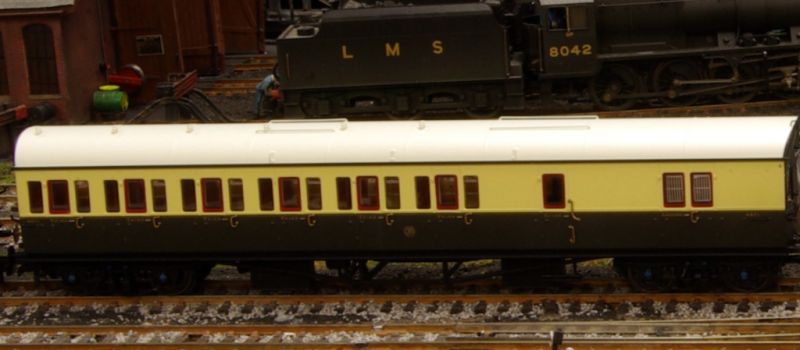
By way of contrast here is one of my twenty year old B Sets

I did a swap with John Flann so it will stay in service……but not too close to the new ones.
Here is the 1st/3rd compo
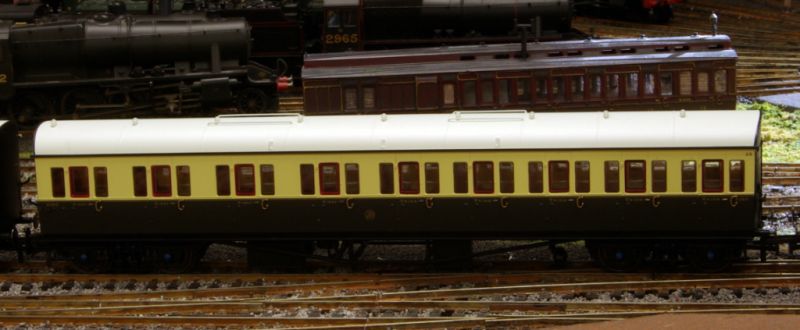
This shot captures the distinctive bow end to the coaches.
The coaches were designed as 4 car sets specifically for high density suburban centres….London, Birmingham, Bristol (?) and, happily for me, Chester.
Like the Collett Bow End Corridor coaches they are handed…..that is to say a 4 car set is made up of a Left Hand Brake 3rd, LH 3rd/1st ,a RH 1st/3rd and RH 3rd Brake. Handing corridor coaches is understandable as all the corridors are lined up on the same side……although in fairness not all stations had platforms on the appropriate side! None of the experts have come up with a clear cut rationale as to why the GWR adopted it for these non corridor sets…..although batteries are now all on the same side for ease of maintenance. When I lined mine up I realised that by handing, the firsts in the two compos become adjacent. So the compartments on the train are divided into three distinct class blocks. Commutors with a 1st class ticket would learn to wait in the middle of the platform and their choice of 8 compartments would be all together
The detail on each coach is brilliant
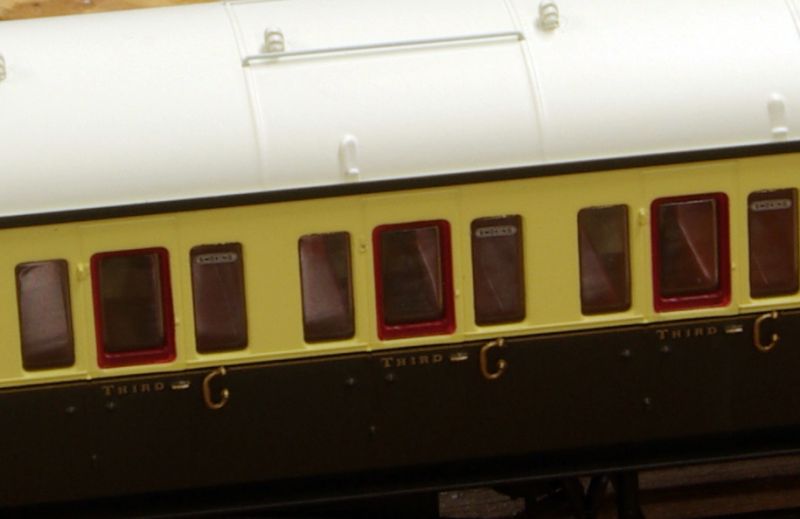
Look at the ventilators……roof hand rails and clips for destination boards…….destination boards are supplied……but when would they be used on a suburban commutor service I wonder.
Super door and window detail……..on the prototype the "Smoking" signs were, I believe, originally etched and subsequently the same effect was achieved with a semi transparent label……the effect is very Art Deco and looks great on the model.

The non smoking signs are less accurate…….White lettering on a red triangle was a BR innovation. The GWR non smoking signs were Red lettering on a white background. Not that I am losing too much sleep about it, particularly because neither I or anyone else noticed the same error on the critically acclaimed corridor coaches that have been around now for almost three years! :oops: :oops:
To finish here is the end view of the third/brake

I think Railtec do coach branding transfers so thats a job for the future.
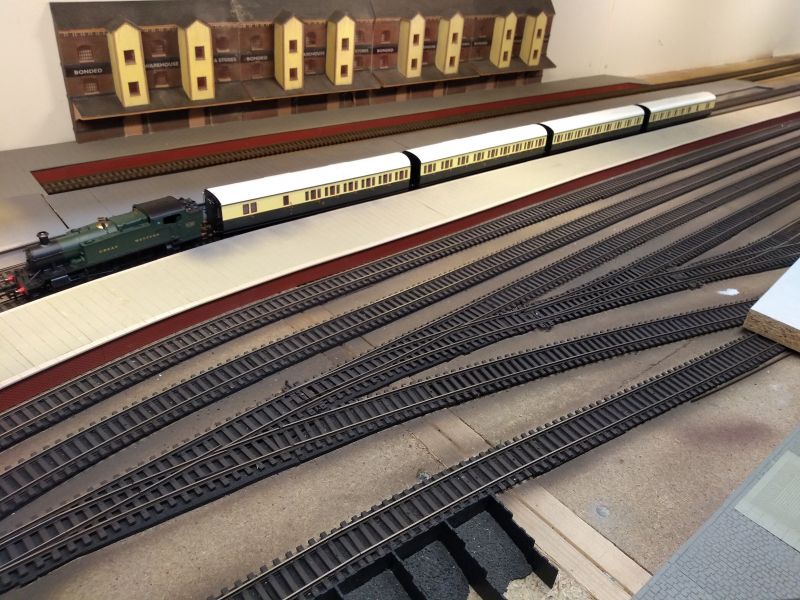
Now I just need the other Brake to make up the set and hopefully in the summer a Large Prairie to haul them.
I have no comment, under any circumstances, about England v Scotland!
I can tell you, though, that the weather here is amazing…..70o and set to continue
Back to the milk train shortly
Posted

Full Member
John, I would presume that on a suburban commuter train the destination boards would be used to show the train's terminus and possibly a route or other indicating number.
Posted
Full Member
Last edit: by 81C
Posted
Full Member
Bill
At 6'4'', Bill is a tall chap, then again, when horizontal he is rather long and people often used to trip over him! . . . and so a nickname was born :)
Posted
Full Member
You needn't worry about the B set being next to a the new coaches as they are different diagrams. The new Colletts didn't run as B sets to my knowledge.
Regards Connor
CC Weathering Services: https://ccgwr1.wixsite.com/ccweatheringservices/
CC Weathering Services Facebook Page: https://www.facebook.com/ccweatheringservices/
CC Weathering Services Facebook Page: https://www.facebook.com/ccweatheringservices/
Posted
Full Member

Posted
Full Member
Michael
Posted
Full Member
How does the your large prairie run ? I tried a couple some years ago but they were very poor…….I am hoping that Hornby's new offering arrive on time be a big improvement…..
Cheers
Posted
Inactive Member
Headmaster, I believe it was indeed fairly common for first trains of the day to have a milk van or tanker (possibly more than one, depending) attached, but my knowledge is second- and thirdhand.
John, I would presume that on a suburban commuter train the destination boards would be used to show the train's terminus and possibly a route or other indicating number.
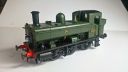
Reading this I thought you might be interested in this "N" gauge loco of mine which I bought on Ebay some years ago. It's had various improvements e.g., the moulded hand rails have been removed and replaced with brass wire ones complete with hand rail knobs, the milk tanker has been fitted with pickups and hard wired to the loco pick-ups to ensure really smooth running plus real coal added to the bunker etc., etc.
Ken

'It don't mean a thing if it ain't got that Swing'
1 guest and 0 members have just viewed this.