
Toggle Switches explained
Posted
#148878
(In Topic #8207)
Full Member
DPDT, on-off-on, and other switch jargon explained
I will try to describe the DPDT toggle switch in this picture.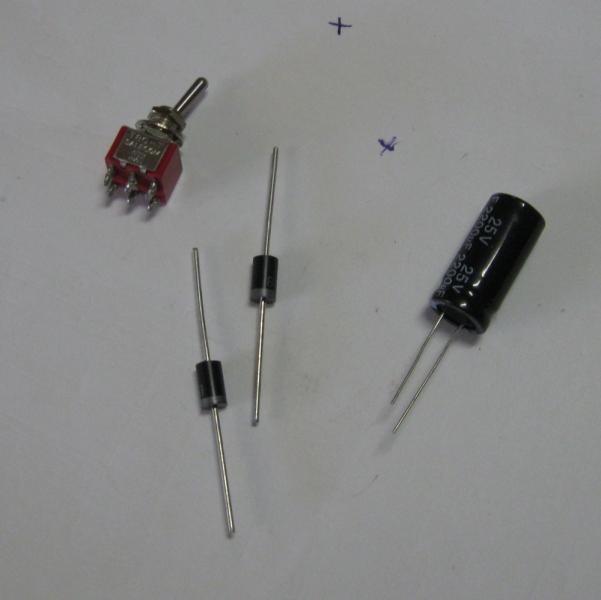
(Photo originally posted by Sol)
Firstly the DP in DPDT stands for Double Pole. This simply means that there are two switches combined in the one casing and both switches operate at exactly the same time when the "toggle" is moved.
Looking at the photo, you will see two almost horizontal rows of solder tags. One row is underneath the other in the photo. Each row has 3 solder tags in it. Each row is one of the two switches in the Double Pole.
So you can use one switch to control the point, and the other to power some LEDs on his control panel.
For now, forget one of the rows. Let's just look at the uppermost row of 3 tags in the photo.
Assuming that you understand a switch with two tags being joined when the switch is thrown. If you just consider the centre tag of the three and one of the others in the row, that is exactly what happens. When the switch is thrown in one direction, those two tags will be joined. However, because it is a DT, or Double Throw switch, then the centre tag is connected to the tag at the other end of the row of three when the switch is thrown in the opposite direction.
This means that the switch is NEVER off. There is always one of the tags at either end of the row connected to the centre tag.
In this circuit diagram:-
(Diagram created by myself back in 2009 using some of the components shown in Sol's photo above)
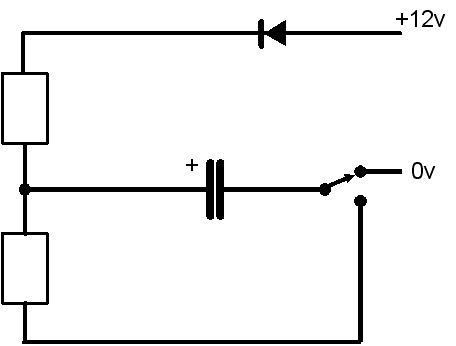
the centre tag of the switch will be the connection made to the capacitor, and the other two tags will be for the two other connections shown for the switch. When one pair of tags are connected, the capacitor will charge up and the point will throw in one direction, and when the switch is moved so that the other pair of tags are connected the capacitor will discharge and the point will throw in the other direction.
Remember that we forgot about one of the rows of tags. Well that is doing exactly the same thing as the top row, just as if it was another switch. Instead of having to throw one switch to set the point, and another to turn on direction LEDs, both will happen at the same time with the one DPDT (Double Pole, Double Throw) switch.
QED!
So if we now understand what DPDT means, you might like to know that you can also buy a DPDT, centre OFF. The tags on such a switch look exactly the same, but the toggle has a central, or perhaps upright position where it will stay put. In this position neither of the outside tags are connected to the central tag.
This is useful if you don't actually want either pair of switch tags to be connected. Movement of the switch will still allow one or the other to be on, but leaving the switch in its central position means that both will be off.
When purchasing such switches you will often find the following descriptions:-
1) DPDT On-On : which describes the switch in Sol's photo.
2) DPDT On-Off-On : which describes the switch I have illustrated just now and what I called DPDT, Centre OFF.
3) DPDT (on)-off-(on) : which seems the same as (2) but it is subtly different. It switches the same, with centre off, but the toggle does not stay in either of the ON positions, unless you hold it there. When you let go, it returns to the centre off position. This is useful if you just want a short pulse of current into a circuit - like a solenoid point motor without a capacitor, for example. This would be instead of a passing contact switch - you do have to remember to let go though, to avoid burning out the motor!
4) DPDT On-Off-(on) : which, as a test I will leave you to work out!!!
Of course all such combinations are also available as SPDT (single pole, or a single switch - just 3 tags). You can also buy a SPST which is the simple on/off switch you already knew. (I don't think I have seen DPST, but they may exist)
Recently I have seen switches as small as Sol's which are 4PDT - again I leave you to work out those ones.
Look up Miniature Toggle Switches and you will find at least 9 different ones which all appear the same, but have the differences described above, so beware if you need to buy any.


Posted

Site staff

Regards
Alan
Born beside the mighty GWR.
Alan
Born beside the mighty GWR.
Posted

Legacy Member
Posted

Full Member
Cheers, Paul
Posted

Full Member
Always try to look on the bright side of life!
Barney
Barney
Posted

Site staff
Toggle switches as depicted in the first post are adequate for our hobby.Do I need to use any particular Amp rating with a switch?
Cheers, Paul
Ron
NCE DCC ; 00 scale UK outline.
NCE DCC ; 00 scale UK outline.
1 guest and 0 members have just viewed this.