
Painting a backscene
Posted
Guest user

Posted

Full Member
I even struggle with that Ron. :lol: :lol: :lol:
'Kev

Posted
Guest user
I've always admired the ability of an artist, but never understood how they went about the task. Now I'm beginning to understand.
Just one queery and this is a real idiot queery … As I've never done any painting and knowing that you use tube acrylics, do you simply squirt out some of each required colour onto a suitable surface and then mix as required? Some basic details on the mechanics of prepairing, mixing etc. would be appreciated.
And a final question … I see acrylic tubes of paint priced from 99p in the cheap shops to £3.99 in art shops for "named" manufacturers. For this type of work, is it worth spending out on the dearer paint?
Posted
Guest user
I have used el cheapos for this, as I did on Swanhurst's backscene and while I couldn't tell you how long ago it was, they still look fresh. Guessing it was about a year ago.
The truth of the matter though is that you only get what you pay for. If your budget runs to it, then buy the dearer ones because their pigments are more concentrated and permanent. That's what I use for my work.
I have some cheap browns that are more like mousse - they seem to be full of air, with no substance to them when you mix.
It's a good idea to spray it all with matt varnish to protect it. The matt varnish is oil based, so you can't touch up with acrylics once you've sprayed it. I still haven't sprayed mine.
The palette I've used is simply greaseproof paper attached with small bulldog clips to a white-painted 20x12 inch sheet of MDF. Painted white because the paper is semi-transparent and it would be hard to see the colours properly.
Some people use 'stay-wet' palettes that have a reservoir of water underneath and paper over the top which keeps the paints wet for longer. I don't bother with that - tried it, didn't like it, and also used baking dishes lined with wet kitchen sponges and paper over the top. No need for that either, really. [in my opinion]
These days I just go with the greaseproof paper and as long as I mist it frequently the paints stay workable indefinitely, with the paper being so tough that it doesn't disintegrate.
I'll gladly write some more about preparing and mixing if you like when I have more time.
Mike
Posted
Guest user
Mike, as a confirmed non-artist, your post is inspirational. It makes me want to have a go. You don't realise how big a statement that is.
I've always admired the ability of an artist, but never understood how they went about the task. Now I'm beginning to understand.
Totally with you on this Jeff, and the questions were not at all daft - I was about to ask them as well!
Thanks for the answers Mike - I also want to have a go as you have made it look so easy, but I am sure in practice it will be different. It's like reading those DIY manuals that show you in about 5 easy steps how to plaster and it starts a total mess and ends up with a smooth polished finish. I start with a total mess and finish with an even bigger one, even though I appear to have done everything exactly as it says!
Posted
Full Member
For another stupid question - is "guache" acrylic paint, oil piant, just another "french" word for colour or what ? :oops::oops::oops::oops::???::???::???:
Oh, by the way, I do know what a paint brush looks like so I'm nearly an artist !!! :roll::roll:
'Petermac
Posted
Guest user
Petermac gouache is just a fancy name for opaque watercolours.
Mike
Posted
Inactive Member
So I've been down to the railway room and looked at this 25 ft wall that needs doing - gulp - and have already come to a full stop before I've even bought the paints because I didn't know where to start.:roll: I'm sorry to trouble you Mike but before I can go any further I'm afraid I need to ask you a question. It is - "How do you work out just where the horizon should be?". This, I would expect, dictates, in general terms, not only the highest point of the backscene (other than the sky) but also the furthest distance, and therefore you must work downwards/forwards from this.
Does this sound reasonable to you Mike? Please be gentle and remember the forum motto - No question is too stupid.

Les
Devon Junction
Kernow Junction
Kernow Junction
Posted
Full Member
:D:D:D
Petermac gouache is just a fancy name for opaque watercolours.
Mike
Thanks Mike - it seems I'm not yet an accomplished artist but I'm on my way !! :???::???:
'Petermac
Posted
Guest user
I've only ever done one, so I'm hardly an authority. All I can tell you is what I did.
I think it's important to have in mind some idea of the landscape you're wanting to depict. Even the most basic sketches on paper will help.
When I started on mine I made an effort to avoid the horizon matching the heights of buildings. In all cases it's higher than the buildings. Lower might have looked better, but I found low-relief buildings looked a bit silly against sky.
When I get the chance I'll dig out a few photos of Swanhurst's in the early stages and upload to Photobucket. Maybe they can help. And I'll try to remember why I did what I did :shock:
Mike
Posted
Guest user
True watercolours are transparent - they won't obliterate or block out anything. Gouache behaves in much the same way as watercolours but is more solid and uses a higher proportion of pigment and I think I'm right in saying white is always present in the mixes to make them opaque. From what I've seen gouache has a more chalky look. I also think acrylics have pretty much made gouache redundant these days.
Mike
Posted
Inactive Member
Les that's a really tough question.
I've only ever done one, so I'm hardly an authority. All I can tell you is what I did.
I think it's important to have in mind some idea of the landscape you're wanting to depict. Even the most basic sketches on paper will help.
When I started on mine I made an effort to avoid the horizon matching the heights of buildings. In all cases it's higher than the buildings. Lower might have looked better, but I found low-relief buildings looked a bit silly against sky.
When I get the chance I'll dig out a few photos of Swanhurst's in the early stages and upload to Photobucket. Maybe they can help. And I'll try to remember why I did what I did :shock:
Mike
Thanks Mike. Sorry to be a pain.
Les
Devon Junction
Kernow Junction
Kernow Junction
Posted
Guest user
In my admittedly limited backscene experience I think horizon height is dependent on building heights. You don't want them to match.
For Swanhurst I painted up some sample backscenes - just on small boards - and placed them around the layout to see what might work.
Low horizon:
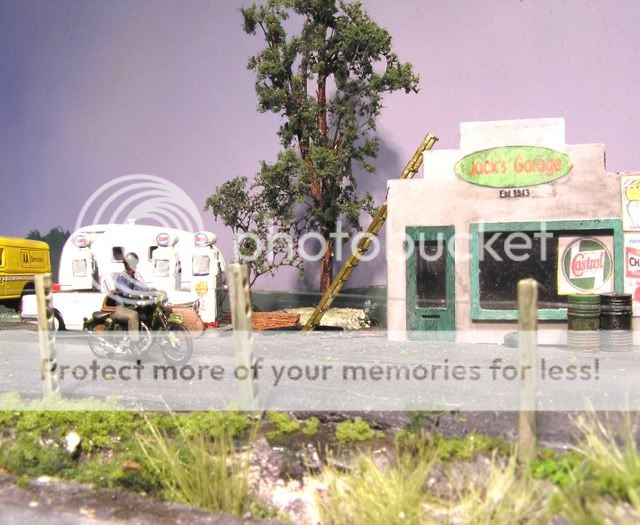
Higher horizon on a photo doctored in Paintshop Pro - hill, building and trees added with the paintbrush tool:
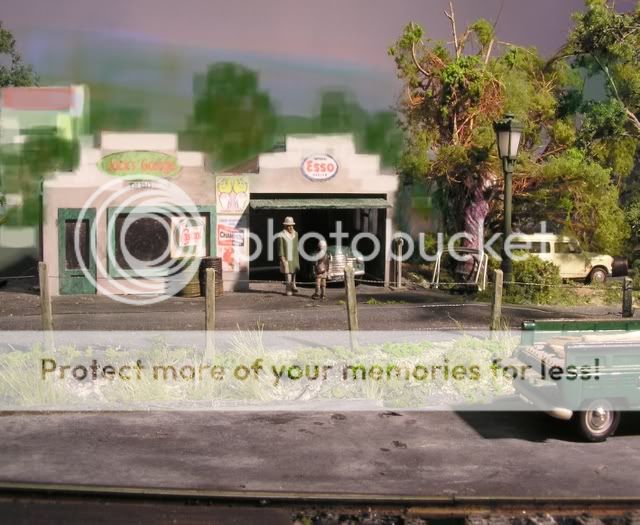
I preferred the higher horizon, so I went with that. Photo before more buildings were painted on:
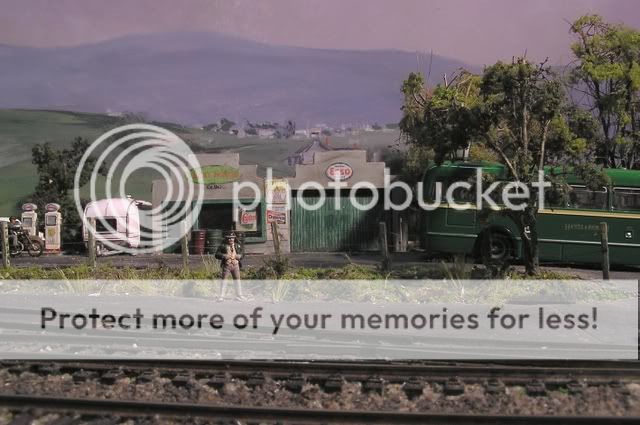
Ended up with this:
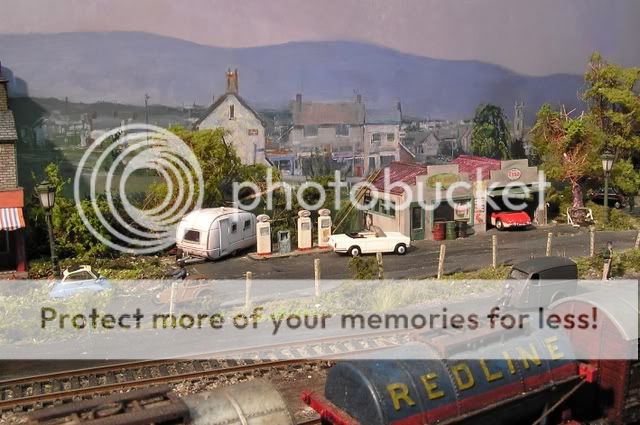
If I had my time again the blue hills/mountains would be lower. Yes I could alter it - some day.
This one shows a horizon lower than the low-relief shops at the left end. I felt they looked odd against a sky:

So I altered it to something that made me feel better about it. A case of pleasing myself :D It looks better from ground level. I doubt the church is prototypically accurate…
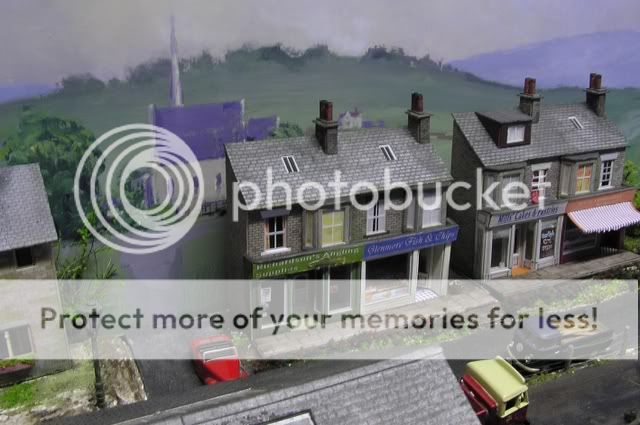

..This one shows a horizon that in my opinion was too close to the height of the shops:
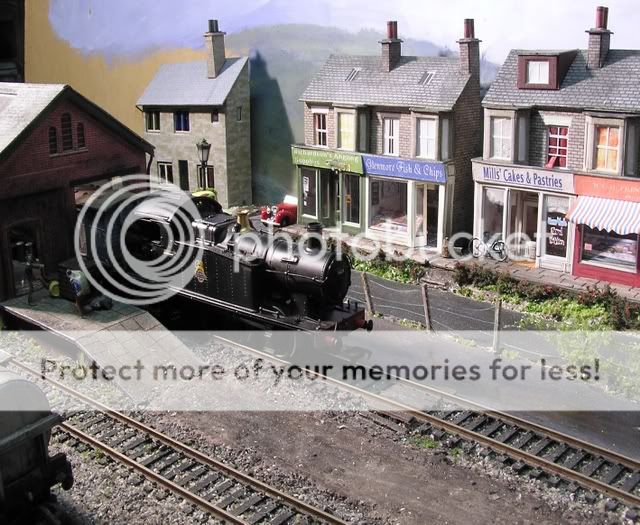
.
Here's the river with a trial backscene:
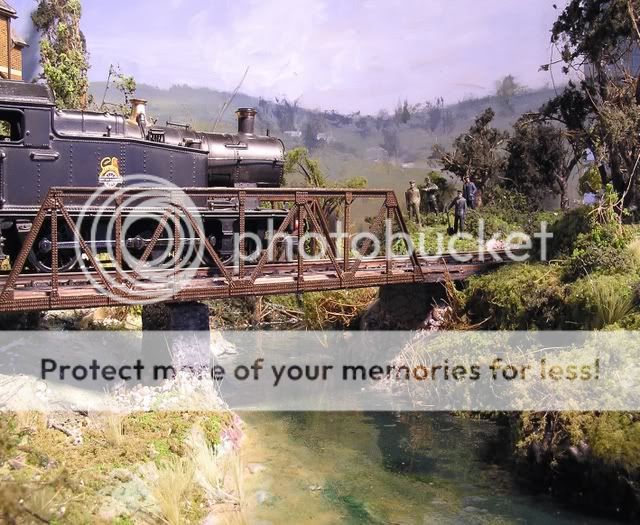
I felt it was too saggy and looked weak, so I went with this:
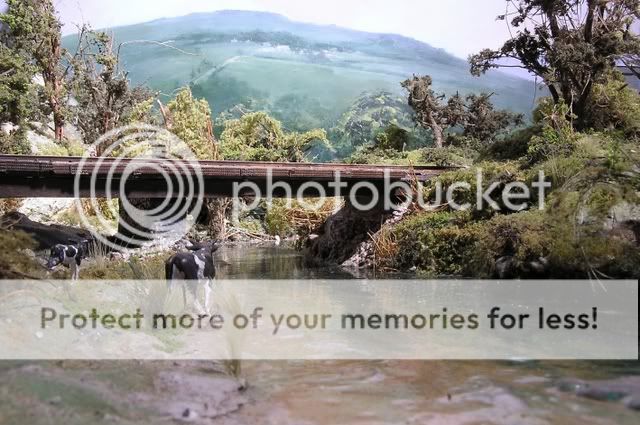
I hope this gives you some ideas.
Mike
Posted
Guest user
I believe that in the last two pictures you have probably unwittingly demonstrated why I am going to fail!!!
Both of the backscenes look amazing, but the second one definitely suits the location better. Trouble is until I saw the second one I had no idea that there was anything "wrong" with the first one! I guess that is the difference between an artist's view and somebody who was ejected from art in school because the teacher could not believe that he was so stupid and must have been deliberately trying to annoy her!
Posted
Guest user
Here in Australia it's fathers day on sunday. So here's what he's getting for his layout [I already gave him the demo version]

and stuck in front of my backscene:
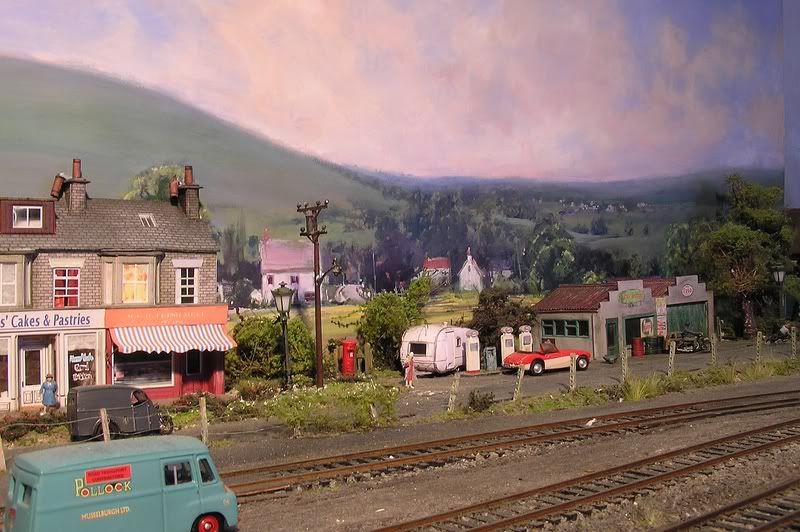
Probably a bit too rural for my village, which is very light on for buidings of its own.
It's 48 x 16 ins. I'd be able to extend it with another alongside if he needs it.
Mike
Posted
Guest user
 Broke my chimney pots getting it in there.
Posted

Full Member
Your dad's a lucky man.
Bit of glue on those chimney pots and she'll be apples mate.
Posted
Guest user
Posted
Guest user
Posted
Guest user
What a lovely personal present for your dad im sure that will have pride of place on his layout.
cheers Brian.W
1 guest and 0 members have just viewed this.