
Painting a backscene
Posted
Guest user

Posted
Guest user
Posted
Guest user
I have just come across this thread and it is quite inspirational.
A couple of questions please?
I have my layout running down one side and across the end of my garage in a L shape.
The length is about 15' x 8' wide. The back boards are 300mm high.
The layout depicts a 1960' passenger station however as it is only 2' wide and only the station platforms and buldings have been modelled.
My back scene will comprise a view across the goods yard showing various buildings e.g. office block, and small warehouse in front of a goods shed, various stores and workshops and a maltings. I intend to paint it on paper and glue it to the back board.
All of the goods buildings have been demolished to make way for a superarket and housing. Though as a result of investigation I do have a good idea of what it looked like.
The railway infrastructure of the back scene will take up about 10' after this it will become more rural and the land around is very flat.
In addition to the buildings I would also like to see a selection of wagons painted in the foreground.
What is the longest practical length of paper I should paint please?
I can scale the buildings and their distances from the station but how do I calculate how large they will be to paint?
Also some of the wagons will be in front of the buildings; how large do I make them please?
Any other advice would be appreciated.
Regards,
Jeff
Posted

Full Member
MikeC will be along but I can tell you that, to do the task in the way you state, you will either need good reference pictures or have a good working knowledge of how perspective is achieved in 2D.
I wouldn't use paper for the job but that is a matter for you. If you do it will have to be well secured
The proprietary printed backscenes only have to be fixed to a backing board but yours will be painted (before or afterwards) and that will tend to warp and bubble the paper.
The longer the piece of paper, the more this will happen.
To start with the question of how big things will be, this can only be judged by you in relation to other things, either physically on the layout or included in your picture.
If you have good reference then this can be used to size things in relation to each other.
However - and this is the part that is essential - you must decide where the viewer will be positioned in relation to your layout and the backscene and design it accordingly.
A further decision is where the 'eye level' will be.
Not as simple as it sounds but, basically, the viewer will be looking up at anything higher than eye level and down on anything below.
In your case, presumably the viewer will be looking down on your layout and and the painting should should reflect this and at the same time tie it into your modelling.
This post is a gross simplification of the process and, when it's finished, it will still be two dimensional.
Hope this helps a little.

Posted
Full Member

Posted
Guest user
You said: "Also some of the wagons will be in front of the buildings; how large do I make them please?"
It's possible there's a mathematical formula or ratio for the apparent size of objects as distance from the viewer increases, but if it exists I admit I've never encountered it, I'm afraid. I'm more a "seat-of-the-pants" kind of person. All I can suggest is you try some paper cutouts and gauge with your eyes how big the wagons and buildings should be. That's what I would do, anyway. I'm sorry I can't be more helpful.
As dd pointed out, there are real pitfalls with linear perspective when you're trying to depict regularly shaped objects like buildings and railway wagons. This is why my backscene buildings are always viewed 'flat-on' to minimise but not totally eliminate their distortion when the layout and backscene are viewed from an angle. Your best bet would be to keep all rollingstock edges extremely soft and somewhat blurred. Even then I'm still not certain it would work.
But there's another problem too - again as dd pointed out - and that is eye level.
If your eye level is low - if you're viewing the layout or taking photos from baseboard level - then a distant wagon painted on the backscene [and assumed to be standing on the same ground level as your model wagon] would appear to be lower than the model because it is farther away. But if your eye level is high, in order for the painted wagon to appear farther away, you would need to paint it farther up the backscene. That's all well and good, but obviously wherever you decide to paint the wagon the backscene will only work from one eye level. From a different level it would look quite bizarre. If you have it set for track-level photos it will look weird from your operating position [unless of course your operating position is track level :lol:]
On my current layout I've managed to overcome the eye level problem to a very small degree by raising and lowering the backscene as required. It lives between the wall and the baseboard's edge and it's propped up on sublayout clutter! I lower it when I'm viewing from down low, and I raise it when I'm viewing from higher places. Perhaps you could try something similar.
High eye level:
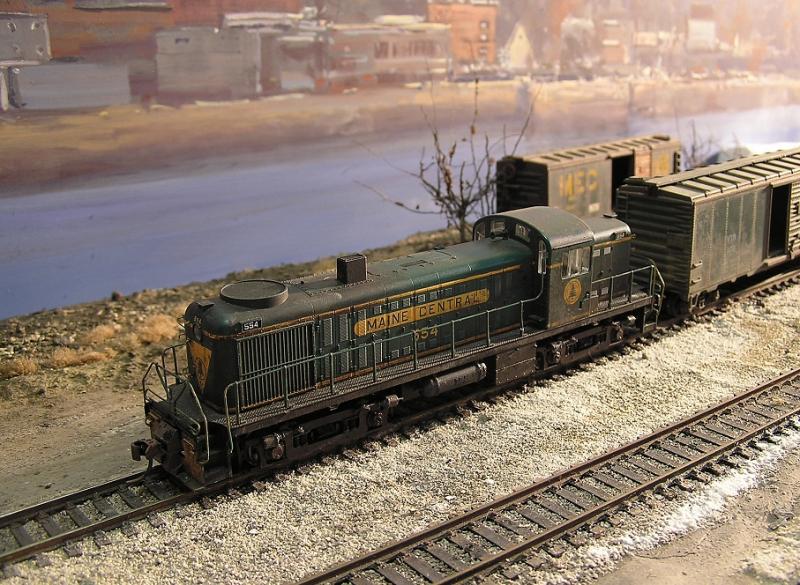
Low eye level - with the backscene lowered…
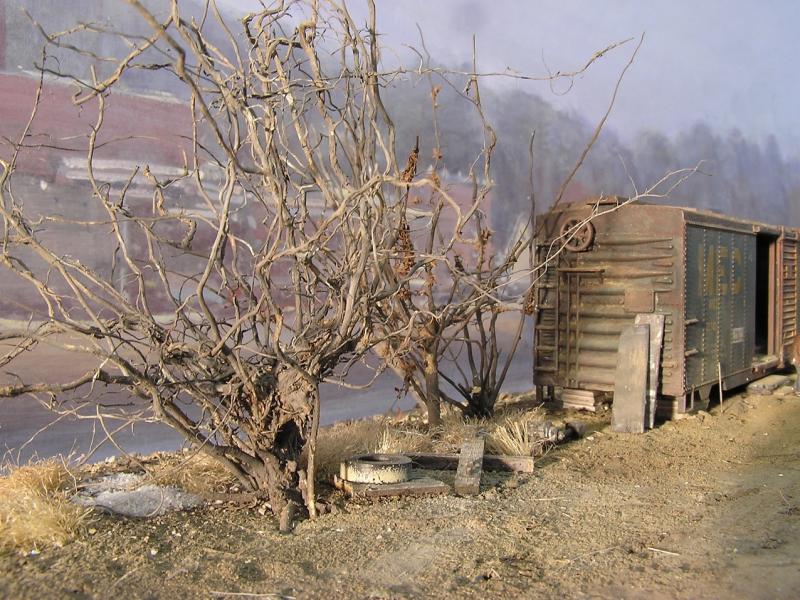
I don't know if this is any help, but I hope it is.
Mike
Posted
Full Member
I think they are models too.
However, it would overcome the eye level problem.
Posted
Guest user
I have no experience with painting backscenes on paper, so I can't really comment there except to say I'd prefer to deal with something more sturdy such as hardboard.
Not trying to pour cold water on your plans and ideas, you understand - just giving my personal opinions. I would love to see how you go and I hope it turns out great!
If you think I or anyone else here can help in any way, please ask!
Mike
Posted
Guest user
As I see it I can opt for an eye level view i.e. as if I were standing at ground level then everything would be just a silhouette or I can go the birds eye view.
I think the ground level view would be the simpler. It will be the relative sizes of those items that are closest to the view compared with those that are some distance away that I have to work out.
In addition unfortunately I cannot make the back scene any higher.
Yes, the more I think about it the more difficulties arise.
Definitely needs more work on what I am trying to achieve. It doesn't have to be exact only to give an impression of the rest of the station site.
Any further thoughts would be appreciated.
Regards,
Jeff
Posted

Full Member
If you can get a photo as a reference to work from, so much the better.
Give it a go, you can always paint over what you have done and have another go.
You'll soon know if you can paint something you'll be happy with… and you won't have wasted a lot of time and materials.
It took me 4 goes to get the clouds that I painted on my backscene over Christmas to the point that I was happy with them.
Cheers
Posted
Full Member
Posted
Guest user
I would just like to ask for further advice in my efforts to paint a back scene for my layout.
It is all about how large something will appear from a distance and if there is a formula.
If I have a building that I know the length of how long will it look at a set distance from it?
For example, I have a plan of the goods shed showing its length to be 160 feet. I am standing a distance of 270 feet away from it.
My question is how large will the building appear?
Or am I making it too simplistic?
Thanks,
Jeff
Posted
Inactive Member
regards,
Derek
 Last edit: by shunter1
Posted
Full Member
You could start with the "Traité des pratiques géometrales et perspectives" published in 1665.
"Studi su la dolcé Prosettiva" by Alessandro Parronchi 1964 provides a simplified tool to help with making the theory practical.
You could Google these, and others on the subject.
However, there is no chance of a simple explanation in a single post.
As I said previously, it is a very complex subject which, to explain would take thousands of words and to reach an understanding would take many more.
Sorry not to be more helpful, Derek, but sometimes there isn't an easy way.
Posted
Full Member
It displays the use of perspective in a way that should be helpful to you.
(eg., look at the floor tiles)

Last edit: by ddolfelin
Posted

Inactive Member
Max
Port Elderley
Port Elderley
Posted
Full Member
I have to put your hair on yet.
Seriously, I wish I could be more helpful on the subject of perspective.
It's something which requires years of study to reach a comfortable understanding of method and result.
Even the Masters (Turner understood it) employed professional 'perspecteurs' to help. Millet, Degas, and others needed assistance.
Having said that, some artists have an 'unconscious' sense of perspective - I think MikeC would be one example by his own admission and results.
Worse still for the beginner, any conventions regarding perspective are obsolete in the face of the manipulation which is possible to achieve effects when objects are close to the eye and which are aimed at perception rather than visual truth.
This is possible with colour and line providing a constancy which fools the eye (as it does in real life).
I usually charge for this stuff.
Posted
Full Member
Hi.
I would just like to ask for further advice in my efforts to paint a back scene for my layout.
It is all about how large something will appear from a distance and if there is a formula.
If I have a building that I know the length of how long will it look at a set distance from it?
For example, I have a plan of the goods shed showing its length to be 160 feet. I am standing a distance of 270 feet away from it.
My question is how large will the building appear?
Or am I making it too simplistic?
Thanks,
Jeff
You could find a building that is about 160ft in length and then take a photo of it from a distance of 270m away. Print the photo out 300mm high and the calculations are all done for you by the camera lens.
Maybe visit the local preserved railway and get permission to take some photos that will give you the look you are after.
Then paint using the photo as a guide.
Posted
Full Member
Jeff is standing 270 feet away - not metres! (winky thing).
However, it's the most simple idea possible under the circumstances.
Posted
Full Member
The box shape I've shown above could be adapted to represent a building 160 feet in length (ie: a known dimension).
By measuring the 'nearest' side of the building as represented and comparing it with the other, it is possible to calculate the apparent diminution of size over horizontal distance.
This ratio could then be applied to any other objects included in the backscene.
Sorted.
1 guest and 0 members have just viewed this.